
It was always going to be a tall order following up a movie like Prey with anything other than a direct sequel or, perhaps, another human-oriented story set in a different era. Then again, I don’t think anyone expected Dan Trachtenberg to make what might be the first universally-liked installment of the Predator franchise since the days of Arnie, Carl and Jesse “The Body,” so if there were anyone capable of pulling off a hard pivot, it would be the man who spun gold from a series that nearly died after Shane Black tried his best to update it for a hyper-modern and irony-steeped horror audience. I don’t think I can overstate how great Prey was — that film approached Creed levels of franchise reinvigoration with its ingenuity and inventiveness while operating in the framework that made the original installment so engrossing — and its consignment to Hulu in lieu of a theatrical release was one of the great shames of the past decade. Yet Trachtenberg’s latest foray into that world, Predator: Badlands, is a decent consolation prize (which also has plenty to say about Prey’s themes), one that’s hampered by a nearly insurmountable conceptual burden yet still manages to be delightfully entertaining thanks to solid writing, well-crafted action, and a fun approach to the deadly ecology of its setting.
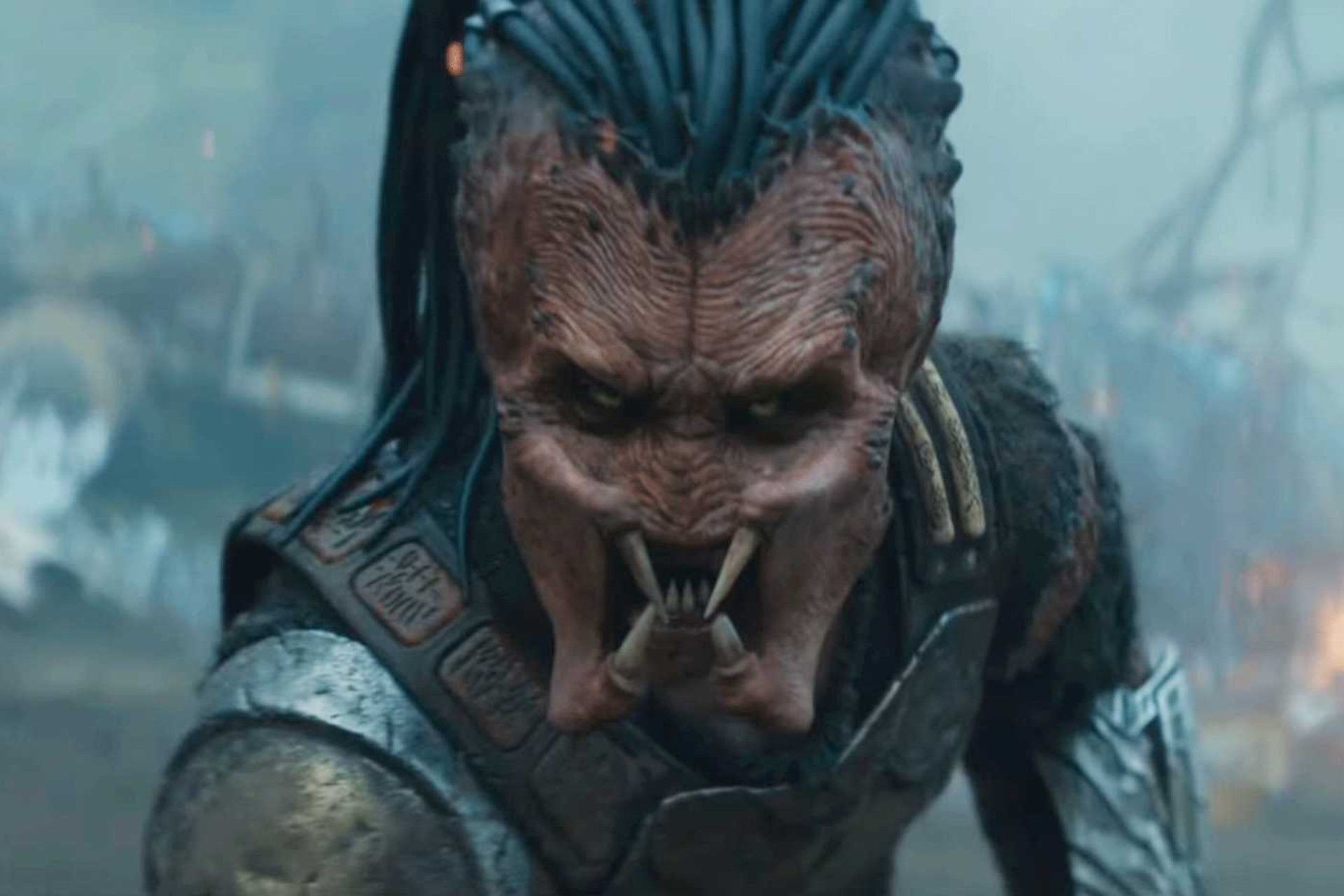
You won’t have to wait long to see what I mean by a “burden.” Right after the film starts, opening on the arid landscape of the Predator homeworld, Yautja* Prime, we’re treated to a fight scene between two Yautja brothers. The smaller of the two, Dek (Dimitrius Schuster-Koloamatangi), gets his ass handed to him by Kwei (Mike Homik), his bigger, taller, stronger sibling. The two take off their masks to discuss Dek’s upcoming hunt — a rite of passage in which a Yautja youth earns “their cloak,” the camouflage device that’s almost as iconic as the three targeting dots emanating from their species’ shoulder-mounted laser cannons. We hear their weird, guttural language and learn more about their tribal dynamics, but I have a hard time believing many folks will pick up on the details in the dialogue — they’ll likely be more distracted by how ferociously weird it looks to see a Predator try to emote. You can say a lot of things about Stan Winston’s iconic design, but you can’t say it was meant for more than the shock reveal at the end of Predator, when Arnold finally gets him to take off the mask and you see that hideous mug behind the metal. To echo Dutch’s reaction, they really are a bunch of ugly motherfuckers, and watching them talk to one another, trying to convey complex feelings through the subtitles of facial expressions, is a tall order that I doubt any filmmaker committed to photorealism in their digital effects would be able to accomplish. It’s just very distracting, forcing the film to swim upstream against a strong current of audience befuddlement.
Trachtenberg spends too long establishing Dek’s arc, in which he has to prove himself to his domineering father, a Darth Vader figure sporting white tendrils and a distinct hatred for his runt son. The Yautja operate like the more mythic depictions of Spartans in media, if they were a semi-nomadic set of clans instead of a city-state, and this means there’s no place for an undersized weakling in their ranks. It’s bizarre that he’s survived this long in such a dynamic, honestly, though his brother’s protection probably spared his life. When Dad shows up and demands that the eldest kill the weakling, Kwei sacrifices his life so that Dek can flee, giving the younger Yautja a front-row seat to his father’s vengeance while sealed behind the plexiglass windows of a spaceship. Knocked out during take-off, Dek crash-lands on the planet Genna, which he chose as the venue for his hunt. Ejected from the vehicle, separated from his fancy weapons and gadgets, the Yautja sets off in pursuit of a mythic creature known as the Kalisk — an organism so feared that even his father was intimidated by it. Yet he’s not alone on his quest, as soon into his journey, he discovers Thia (Elle Fanning), a damaged Weyland-Yutani synth, trapped in a creature’s nest. She was separated from her exploration team (and the lower half of her body) when they encountered the Kalisk, and she pleads with Dek to take him with her. He obliges only after Thia suggests she view him as a “tool” to help him on his journey, though the android has her own designs for the Predator.
Genna may not be the best vacation destination, but it is a fun setting for Trachtenberg’s tale, given that it’s essentially the Australia of planets. Everything there seems to want to kill Dek, and it often comes very close to doing so. Root-like vines surge forth from the forest, looking to tear limbs off of whatever threatens them. There are pterodactyl-like flying creatures that have developed a symbiotic relationship with a plant that shoots thistles coated in a paralyzing poison. Should one get close enough to its stalks, wander into the wrong field, the flying beast will drop a rock in one’s path, causing the motion-activated automatic response to go off. Tiny eel-like critters will spray you with acid from their nests inside the rocky walls near a creek. Then, of course, there’s the Kalisk, which looks like what might have resulted if the Cloverfield kaiju were crossed with a lion, which can heal itself from nearly any wound, making any attempt at trophy-hunting almost totally irrelevant. Even the tall grass has leaves of razor-sharp glass, and the only creature with skin thick enough to get to it is a little green monster — think Baby Godzilla from the Showa era films — who Thia affectionately dubs “Bud.”
It’s clear that a ton of thought and consideration went into crafting this world, which is nicely contrasted with the inhuman coldness of Weyland-Yutani’s Hideo Koijima-like aesthetic (the vibe here feels as if it were directly pulled from Death Stranding or its sequel in its high-contrast colors and the presence of Fanning, one of the game’s stars, whose costume designs echo her character there). Trachtenberg uses his spaces well, ensuring that each image looks purposefully striking and that each detail casually dropped is picked up later on for a pay-off once the going gets bloody. Or, as this is a PG-13 feature, alien-bloody with a dash of milky synth fluid splattered alongside it. As much as some might lament the lack of “real” gore, this isn’t Alien vs. Predator — the action is good, with the big third-act set-piece being a particular standout — and blood of a different color wouldn’t have changed that too much. After all, given that Thia’s exploratory group is made up entirely of androids, they’ve got plenty of inorganic life to murder.
Continuing the trend established in Alien: Romulus, Fanning is closer to Bishop on the scale of robo-reliability than Ash or Prometheus’s David, and her presence adds an interesting dimension to the story. She’s got an effervescent attitude towards the native flora and fauna, which puts her at odds with the company’s goals and the rest of her team, who lurk in the background, led by her “sister” Tessa (also Fanning), an identical android who is much less compassionate to the forms of life she encounters. You can probably see where this is headed – the ingredients are there for a “chosen family” to assemble, and Trachtenberg won’t disappoint you. That said, the “odd couple” pairing is a strong asset, especially when Fanning does the heavy emotional lifting. They’re both committed yet doubting naifs, dissatisfied with their lot yet compelled to see their task out to the bitter end, and is an intriguing twist on the traditional Predator format and the type of colonial critique that Prey inverted from the original. One could argue that it’s somewhat misplaced after the last film, which, by design, went much harder than the original in its condemnation of exploitation and adventurism, but it’s an interesting iteration on these themes, in which our characters learn to see each other as sentient beings rather than the means to an end. This time, the circumstances allow for such development, and it plays well, even if the edge is duller than it has been.
So, Badlands isn’t on par with Prey or the original Predator, but it’s roughly on par with the underrated Predator 2, significantly better than Predators, and dramatically more audience-friendly than The Predator, which remains one of the most bizarre yet entertaining misfires to emerge from Zombie Fox ever since the Disney acquisition. Yet it’s more committed to telling its own fresh story than something like Alien: Romulus, which, as fun as it was, had too many forced allusions to prior entries in the franchise (thank God there’s not an AI-generated Ian Holm here to walk us through some exposition). Beyond what I outlined above – Prey, but in a different setting, as explored in Predator: Killer of Killers – it’s a worthwhile step forward for the franchise, and, should it be successful, I’m excited to see where Trachtenberg takes us next on his tour of the worst possible places in the universe for one to find themselves trapped in. Of course, that all depends on whether or not opening weekend crowds will be able to stop their thoughts from drifting to concerns like “How the hell do the Predators talk when their mouths look like that? They don’t have lips,” or “Man, I never realized how important eyebrows were until right now.”
* “Yautja” is the expanded-universe name for the Predator species, adopted here in a way that doesn’t feel particularly organic.