
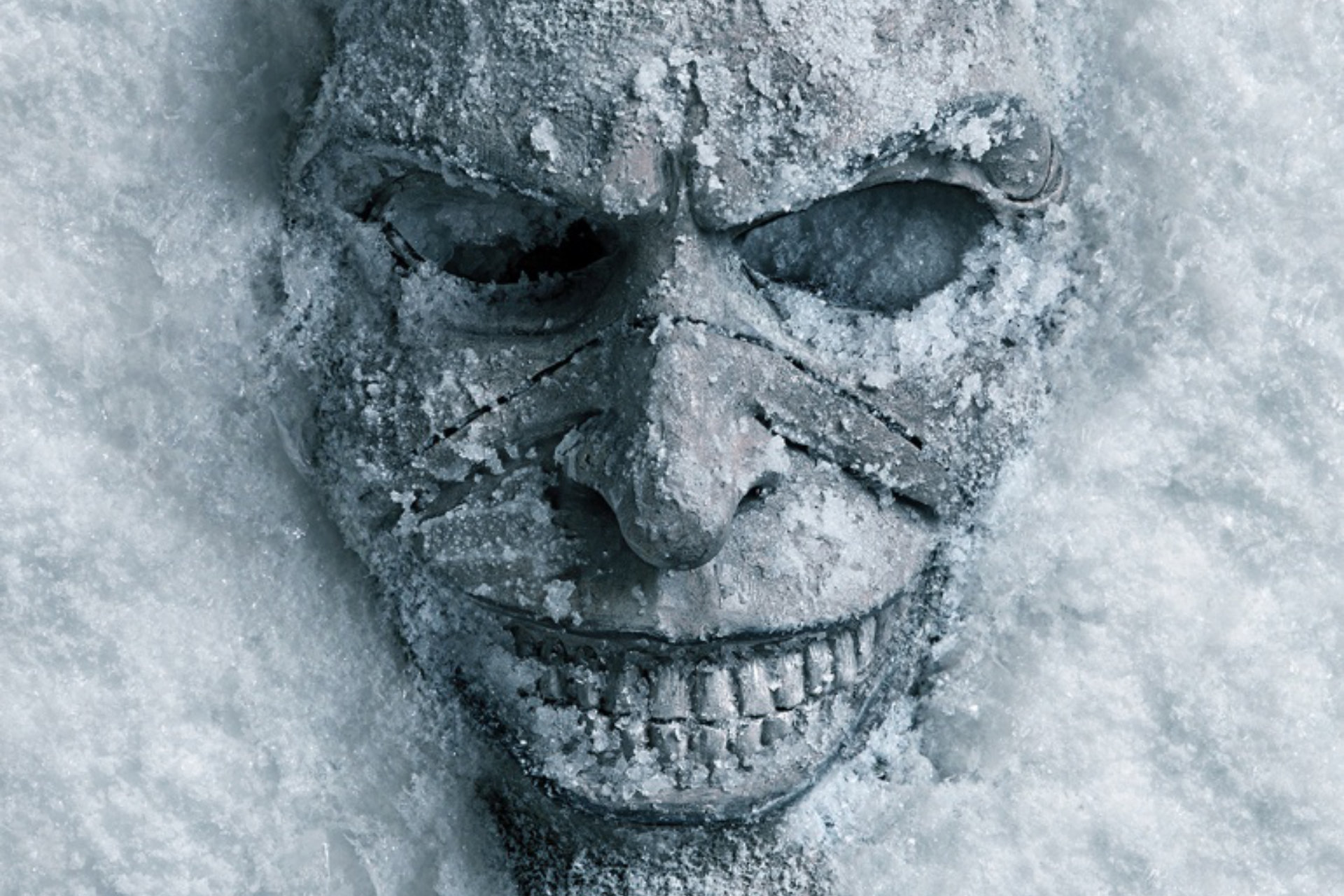
I’ll give Scott Derrickson this: It takes a lot of guts to decide that what audiences want from a Black Phone sequel is to see the masked killer known as the Grabber (Ethan Hawke) show off his post-mortem skills as an ice-skating pro. That sequence, which acts as the final setpiece of Black Phone 2, is both a direct tribute to the iconic, hilarious kill in Richard Ciupka and Peter R. Simpson’s Curtains, in which a similarly-guised slasher decides to put a victim on ice, and an admission that they probably shouldn’t have made a franchise out of what was, after the director’s brief tenure at Marvel, a pretty solid little horror feature.
Admittedly, it was somewhat fortuitous that it did – it sat on the shelf a bit after Omicron and had some decent returns once it finally hit theaters in Summer 2022. Per usual, the only thing standing between you and the contrivances required to ensure your life after death is whether or not you’ve got sequel potential, so the Grabber was likewise resurrected as a disembodied spirit and set loose on a snowed-in Christian Camp in the Colorado mountains, where he could be a ghostly goon launching haymakers on those who’d threaten the stiffs behind him. No, it never gets slapstick enough to see Hawke lift someone’s shirt over their head while launching missile-like uppercuts, but it comes pretty goddamned close.
This isn’t a premise too far afield from what the first Black Phone established as the rules of its world, where dead kids can dial a metaphysical hotline to communicate with the living to solve their deaths and prevent them from befalling the same fates. Life after death is a guarantee, psychic kids exist and can communicate with others that have “the gift,” and if there’s an axe, you better bet it’s gonna get used: if this sounds familiar, well, it’s by design. Derrickson, apparently thinking that the subtle notes of Stephen King’s influence on the horror stories penned by the horror master’s son, Joe Hill (who wrote the short story upon which the franchise is based), weren’t obvious enough in the vintage, heightens their acridity by adding saccharine allusions to The Shining to the barrel like an Austrian winemaker deciding that some antifreeze might liven up his late-harvest whites. Get ready for some stark lighting from a plow’s headlights and creepy visions of children pursued through the snow-covered woods, because that’s what replaces the original’s taught scares, sense of desperation, and otherworldly high strangeness in the sequel. Oh, and you better bet that the Blakes are back – the Grabber’s still got scores to settle, and a hereditary family “curse” of second sight is just the way to get it done.
We kick off with Gwen (Madeline McGraw), the youngest and most psychic of the Blake kids, getting a collect call from her deceased mother from decades earlier. It’s 1982, and her mother is calling 1957 at a conspicuously-placed phone booth near the camp’s frozen-over lake, and is somehow not using a ham radio to communicate, given that we’re going off of Frequency logic. They’ve both had disturbing dreams – mutilated children in the lake, carving communiques in the ice, with one key difference between them. Her mom sees numbers (that’s how she knew to call), and Gwen sees letters, specifically “W-B-K” with each boy supplying a different character. She doesn’t know what it means, but she knows her dreams mean something. Those visions were, after all, how she was able to find her brother Finn (Mason Thames), the Grabber’s last would-be victim. He, with her help, brought the killer’s reign of terror to an end back in 1978, and has been living with the consequences ever since, hearing phones ring with the desperate pleas of dead kids every time he passes by a payphone, and beating the shit out of the bullies who try to challenge him given that he’s the only one at the high school with a non-sexual body count. He’s too lonely and isolated for that anyway, choosing to get stoned to numb the pain, much like his dad (Jeremy Davies) turned to the bottle after his wife killed herself (at least the kid’s got cable so that he can veg out to some new wave on Night Flight on the Superstation). Finn begrudgingly agrees to go along with her to become a “councilor-in-training” at the reopened camp. They’re driven there by Ernesto (Miguel Mora), the younger brother of Robin, the kid who called from beyond the grave to help out Finn when he was in the Grabber’s basement, and who is nursing a serious crush on Gwen, about which Finn’s none-too-pleased.
They climb the mountain in Ernesto’s car, snow and wind obscuring nearly everything, Derrickson making a solid choice to wordlessly soundtrack the slow-motion scenes of chaos on the roads with the creepy vibes of “Another Brick in the Wall (Part One).” When they get to the grounds, they’re told by the camp’s owner, Armando (a genial, warm Demian Bichir), that the session’s been cancelled, and, aside from three other members of the year-round staff, that they’re the only folks up there. That’s when Gwen starts to have particularly violent dreams – the kids begging her to find them and save them – bearing the scars of their still-burning flesh on her arms after, and Finn starts getting calls with a familiar voice on the other end of the line. It’s the Grabber, who has seen Hell and decided he’s evil enough (and that the kids are isolated enough) for him to enact his vengeance. With the power of the three dead boys’ fear propelling him, he’s back in the land of the living in ghostly form, ready to take everything away from the kid who caused him to kill his brother and who caused him to lose “all the good parts” of himself in the frozen wastelands of the underworld. That, of course, is Gwen, the one spot of light in Finn’s miserable, pitch-black life, and the sands start trickling down the hourglass for the Blakes – find the kids’ bodies, stop the Grabber, save their lives.
This isn’t a great expansion of The Black Phone’s nascent mythos, but there’s enough there that one could probably wring something better than what wound up on screen. At 114 minutes, it’s almost a quarter-hour longer than the original, with little to show for it, as the propulsion of that narrative is replaced here by tedious wanderings and a lack of immediate stakes. As nice as it is to see the low-fi dream landscapes of Gwen’s visions elongated here in the haze of Derrickson’s faux-8mm, they cause the story’s wheels to spin out like they’re caught in a snow drift. Bizarrely, it’s preachy as well – the camp is outfitted with two Bad Christians who get their just desserts after conflicting with Gwen’s personal relationship with Christ, and a third-act speech given by her to Finn about his drug use seems to have anticipated Nancy Reagan by a half-decade*.
But the main flaw is that Black Phone 2 lacks its killer, who served as a central mystery for the film to coalesce around. Hawke’s limited to the occasional ghostly appearance, stripped of the striking physical transformations and odd personal quirks that made him an above-average horror villain. He was a weirdo who had contracted something otherworldly in his psychic ether, and that was interesting, well-paired with the supernatural conceit. It may have taken Tommy Jarvis for the Friday the 13th series to embrace the potential in a zombified Jason, but at least it had the juice to get there. To be fair, I didn’t see The Black Phone getting a sequel, so perhaps it will get to Black Phone VI: The Call You’ve Made Cannot Be Completed As Dead for a full-fledged Hawke outing again. I doubt it will, but, hey, stranger things have happened.
* Then again, if the Grabber had struck two years later, the Blakes would have been well-informed on what to do when a malevolent entity stalks your dreams, provided they’d been able to see Nightmare on Elm Street when it hit theaters, and we wouldn’t have much of a movie here, would we?