
You could argue that by the time Stephen King published The Long Walk under the pseudonym “Richard Bachman” in 1979, nearly 15 years after he started it, the idea of a “national sport as cover for totalitarian government’s machinations” had already been pretty well-trod ground for genre fiction. I hesitate to use Juvenal’s “panem et circenses” to refer to this type of story simply because he was mainly arguing against the state feeding Roman citizens in the same kind of “bootstrap” bullshit that suffuses modern discourse on welfare. Yet the popular idea of “bread and circuses” in the age of mass entertainment had existed for decades by the time King put pen to paper in the mid ‘60s – Orwell, Huxley, Forster, and Bradbury had already made it a central focus of dystopian works.
The advent of televised mass-media sport really came of age in the ‘70s, and fiction changed to reflect this, especially as it moved onto the screen. His prescience was delayed, however, by the decade-long wait for King to publish the novel. By then, Norman Jewison’s Rollerball had hit theaters just a few years earlier in 1975, in which James Caan proved that a bellwether for brand-American dystopia was the popularity of roller derby, alongside Paul Bartel’s Death Race 2000, which portrayed a future that was only somewhat more deadly than racing was at the time. This is a lot to say that you don’t even need to cite The Hunger Games or Battle Royale to get why Francis Lawrence’s adaptation feels stale: It’s a tale nearly as old as large centralized government itself, one repeated ad infinitum in a distraction-saturated age.
A pithy summary could simply say “a bunch of kids walk at gunpoint and some get shot and then one wins,” but that undersells just how pernicious the Long Walk really is. It’s a nearly-endless march conducted each year by a totalitarian government that emerged in the wake of a war so catastrophic that it essentially pressed the pause button on, say, 1972 for the decades that followed. One hundred young men, selected each year from a nationwide “lottery,” are hustled up to the starting line in Maine. There, they’re given tubes of pureed food, a canteen full of water, and, most importantly, a speedometer which measures their pace. If a walker falls under three miles per hour, they get a warning. If they get three warnings in an hour, they’ll get their “ticket punched:” A face full of hot lead courtesy of the soldiers walking alongside the pack or seated on one of the armored military vehicles (one, of course, contains a camera). There’s a set start but no established endpoint – the “race” ends when the runner-up collapses and gets shot in the head by one of the guards walking alongside the winner. As established by the Major (Mark Hamill), an Il Duce-like figure who emerges in a Jeep to provide mock encouragement for the participants, they’re doing this for more than just prize money or a “wish” granted to them by the state: They’re marching towards a glorious, strong new America that can only be nourished by the blood of the young.
Our main character is Garrity (Cooper Hoffman), the “hometown hero” of this year’s competition, who’s from the Maine town right near the start. He’s what you’d call a “normal” kid in this world – he’s been fucked with by the regime (his dad got shot in the head by Luke Skywalker, which would fuck me up too) as much as anybody else has, but he grew up in idyllic circumstances compared to some of his fellow Walkers. McVries (the wonderful David Jonsson, though he struggles here with an American accent), the first person to extend a warm hand to Garrity upon his arrival, grew up an orphan after his family died in the war and bears scars to show it. Yet the two have dramatically different outlooks on life, with Garrity having succumbed to a grief-centric nihilism, plotting how he’ll use his reward to exact vengeance, and McVries doing everything he can to stand for optimism and kindness in the face of fascist terror, including helping out his fellow walkers.
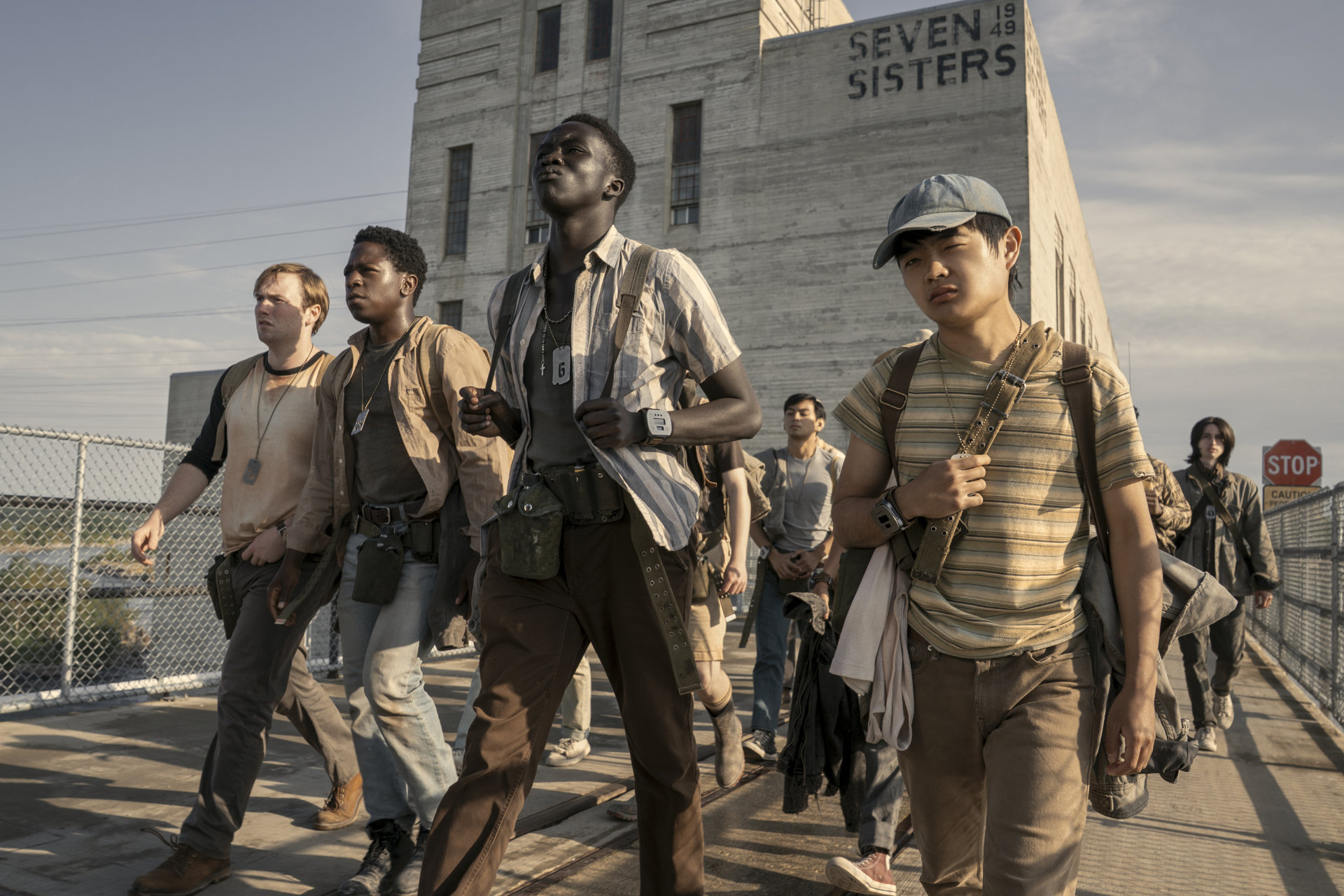
Along with Hank (Ben Wang) and Baker (Tut Nyuot), they form the “four musketeers,” looking out for each other over the course of the Walk. As it drags on into the second day, it becomes clear that they’ve got some opposition: there’s Barkovitch (Charlie Plummer), a genuinely unwell little fucker spouting off like Dennis Hopper in Apocalypse Now!; Parker (Joshua Odjick), the brooding representation of a “chaotic neutral” character alignment; and Stebbins (Garrett Wareing), who treats this like it’s just another competition. He even has sneakers to change into, though who knows when he’ll be able to stop to do so. Four friends, 96 other challengers, and yet there can only be one winner.
This novel was a white whale for a murderer’s row of directors – George Romero, Frank Darabont, Andre Ovredal – and Lawrence, with his prior experience with the “teenagers getting killed for entertainment purposes by a fascist government” genre (he directed four of the Hunger Games sequels and prequels, with another on the way next year), presumably seemed like the right choice. I don’t think he’s really right for this role, though he does do a good job with the more action-heavy sequences, such as a genuinely stressful nighttime sequence in which the already-tired Walkers have to head up a steep hill, with warnings and shots ringing out over Hoffman’s head as he strains to hit that three-mile-per-hour pace. The ensemble is also strong, with “the Four Musketeers” sharing an easy camaraderie and the rest of the cast acquitting themselves well (including Hamill, growling encouragement from the back of his Jeep).
Yet I think any director would have stumbled into the same issues that Lawrence does here. It’s one thing to read a book like The Long Walk and say to yourself, “Boy, that was a great read. What a concept! Someone should make that into a movie.” It’s another to try to take the close psychic distance the reader has from a protagonist in a novel and translate it to the big screen, where everything happens at a remove. As such, it’s a lot of walking and talking, where a whole bunch of kids chat about that big old boat called the “S.S. Live Forever” that they’re going to sail off on right before they catch a slug to the cranium from a carbine for bending over to tie their shoes or take a shit.
It all happens so fast – unless you speed-read, you’re going to spend several hours with King’s book, while Lawrence can barely stretch this to 108 minutes, and as a result, it never feels particularly punishing outside of the most brutal moments of gore. I don’t think it despairs enough. Yes, I wish this were longer, though as much as the eight-hour slow cinema version of this might have kicked ass, I know that’s not exactly a blockbuster in the making. What might have been stronger is if the adaptation were as faithful to the book as it claims to be, as many of the rough edges have been sanded down to facilitate the newfound ideological opposition between Hoffman and Jonsson’s characters (say, the deep-seated insecurities that the characters have in the book that are absent from their profiles in the film). Even worse, Lawrence and writer JT Mollner change the ending to accommodate it, which dilutes the sort of Orwell-esque nature of the original story. Values are flipped upside down in defiance of the regime, rather than one’s soul being ground into dust by authoritarian brutality.
There’s hope, for whatever reason, in the tiniest of spots, and that’s not really the point of the whole thing – there is no rebellion or subversion. You just have to walk. It’s just such a strange choice when you consider how academic much of this is – Lawrence goes out of his way to highlight how the tale is a metaphor for the anxious stew of emotion brewing inside of every potential draftee during the Vietnam War (this is the whole reason for the period setting, as well as it being just slightly more plausible in an era before cell phones). Perhaps The Long Walk should have been left behind in the past, though the political poignancy of King’s work endures as always, along with his mastery of storytelling – but it should definitely have been left on the page.