
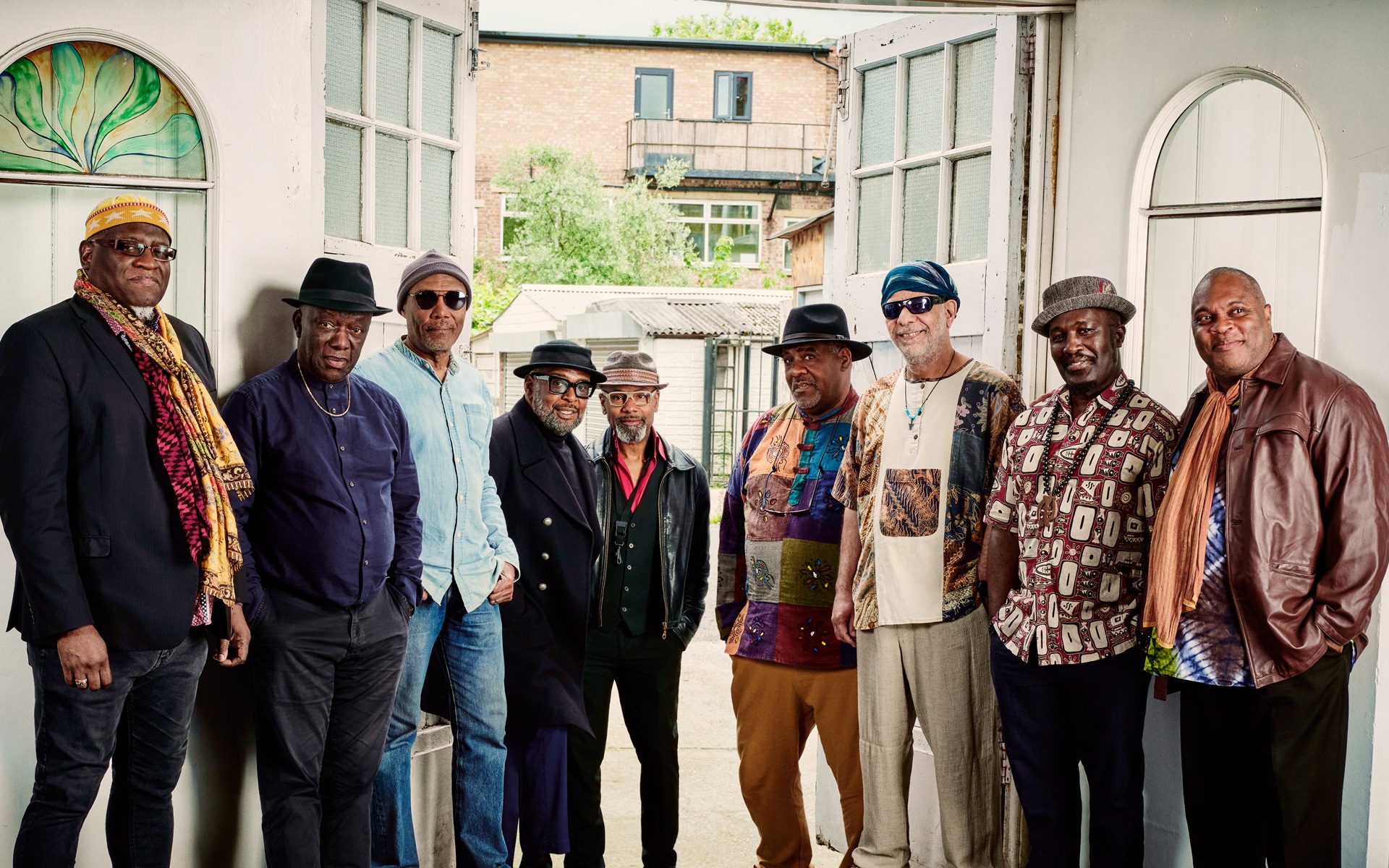
It’s rare in music for an artist to have a second act, and even more so to be recognized for their undeniable impact on entire genres. But it does happen, as is the case with Cymande, a footnote British psychedelic funk outfit from the early ‘70s who later found themselves as one of the building blocks to the foundation of hip-hop, along with being an influence on the UK’s underground rare groove scene.
Guitarist Patrick Patterson and bassist Steve Scipio, childhood friends whose families immigrated to England from Guyana, formed the sprawling collective Cymande in 1971 London after spending time in the jazz fusion scene. Feeling stymied by the region’s racism and xenophobia, especially towards a group whose lyrics delivered socially conscious messages, they called it quits just three years after getting started. Patterson and Scipio retreated to the Caribbean, where they each pursued a career as a lawyer.
Then, a funny thing happened. New generations discovered the music spread across the first few Cymande records, with up-and-coming artists cherry-picking elements of it for breakbeats and samples. The band became an essential go-to for burgeoning and established hip-hop artists, from the Sugarhill Gang and Kool Herc to Gang Starr and Wu-Tang Clan. Scipio was caught off guard when his son approached him after noticing pieces of his father’s music throughout the music he was hearing in the mid-’90s.
“I wasn’t really listening to hip-hop or rap or any of that stuff that was going on at the time,” Scipio tells Vanyaland ahead of Cymande’s show tonight (July 31) at The Paradise Rock Club. “So, it was not until my son said, ‘I’ve heard this thing and I’m sure it’s a bit of your music,’ and he brought it to my attention. I said, ‘Hmmm… yes, that’s very interesting.’ Then I shared it with Patrick, and he said, ‘Oh, yes.’ But I still didn’t take much of an interest, to be honest. I thought it was just maybe a passing phase or something.”
***
It wasn’t until hearing the title track to the gazillion-selling Fugees LP The Score in 1996 that Scipio detected the unmistakable groove of Cymande’s 1972 song “Dove” and it really hit just how much of an importance their music had become.
“When the Fugees really took it on board, that’s when I said, something must be happening with this music,” he adds. And that’s when I started to show more interest in what was happening with the younger musicians and the sampling of the songs and so on.”
Following a successful copyright lawsuit against Fugees for illegally using the sample, Patterson and Scipio began putting Cymande back together, starting with their first LP in 41 years, 2015’s A Simple Act of Faith. The record was a bit of a test drive for this year’s Renascence, which captures a perfect balance of the psychedelic soul-fueled funk that fostered attention for them in the first place, in tandem with contemporary steps forward, namely in collaborations with Soul II Soul’s Jazzie B and Brit R&B singer Celeste on separate tracks.
“Jazzie B had always wanted to do something with us because he also connects a bit with our past; he’s a bit younger than us, but also connected with our past,” Scipio says. “[Celeste] approached us actually to do something with us, and we had no hesitation in bringing her onboard – both her and Jazzie B – because it’s something that Patrick and I had talked about for some time that it would be nice to connect with some of these young, good musicians who have heard of Cymande and that express an interest also of working with Cymande.”
Last year, a documentary on the rebirth, Getting It Back: The Story of Cymande, drew rave reviews, and now it’s fans who are expressing an interest, with The Paradise the penultimate gig of a short tour of North America. But before they head back to Europe next month for a string of shows, concluding with London, the city that once shunned them, Cymande will perform this Saturday (August 2) at the Newport Jazz Festival.
“It is one of the high points of our musical career,” Scipio says, comparing it to the time in 1973 when they were the first British band to play the Apollo Theater in Harlem, before bringing it back to present day. “We played Glastonbury a couple of weeks ago in the UK, and as you know, Glastonbury is probably the premier festival in the UK, and that was an achievement [there].”
“Now, Newport Jazz, since I was in my teens, I was listening to all the famous jazz musicians. Many of them were releasing live albums [from] Newport Jazz. So, a lot of those live albums I was listening to, if anyone had told me at that time as a budding young musician in my teens that I’d one day be playing the Newport Jazz, I’d say, ‘No, no way. [laughs] Get out of here.’”
He and the rest of the group will also find themselves in a curious situation at Newport Jazz, performing the same day as De La Soul, who sampled Cymande’s 1972 track “Bra” for the song “Change in Speak” on their 1989 debut 3 Feet High and Rising.
“I’m very much looking forward to it,” Scipio says of the chance to meet De La Soul. “They were the first that I heard sampling our music, and I’d like to hear from them what was it that inspired them about the music to make them feel that this is something they could use as a vehicle for their own creativity.”
CYMANDE + ADAM GIBBONS :: Thursday, July 31 at the Paradise Rock Club, 967 Commonwealth Ave. in Boston, MA :: 8 p.m., 18-plus, $36 :: Event info :: Advance tickets