
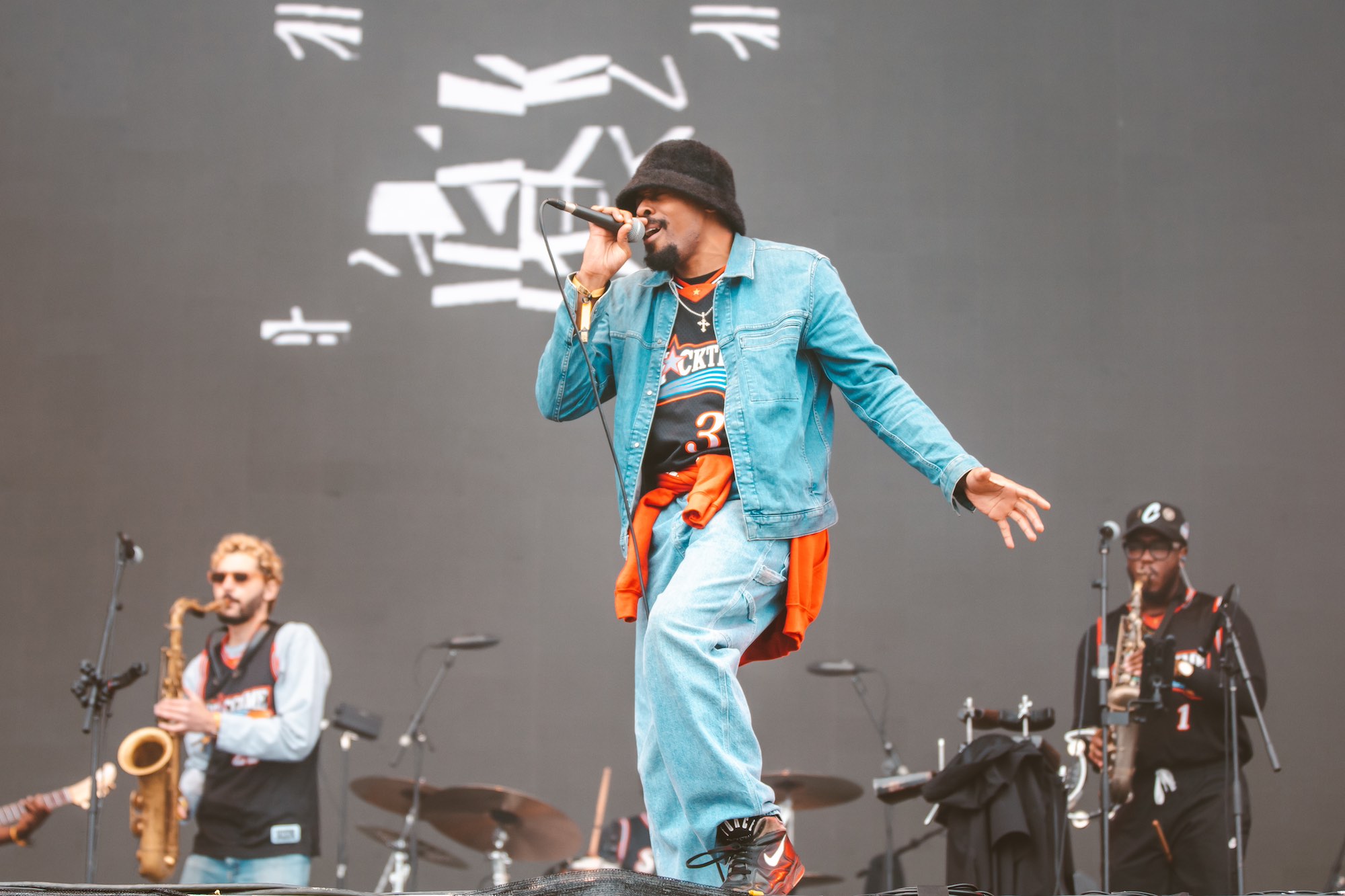
Sunday’s early birds at Boston Calling know that SNACKTIME is actually a full sonic buffet. When kicking off the fest’s final day, the crew of Philadelphia bandmates served up heaping portions of funk and party-pop, plus a side of contagious goodwill. (You might even go so far as to call the entire affair “spiritually filling.”)
After their performance on the Green Stage, the group sat down to chat about the power of festivals as platforms, wearing their love for Philadelphia on their sleeves, and whether or not “tasty” is actually a good adjective for describing music.
Victoria Wasylak: I love that the Philly contingent is so strong today. Can you tell me a little bit about what the Philly music scene is like, and what you were hoping to bring from it when you performed earlier today?
Yesseh Furaha-Ali: That’s a great segue to go into the Philly invasion of Boston Calling. We’re out here. It’s a very special thing to see homies that you recognize and that you know, and that you also grew up with and played with in the local scenes — to know that we’re both making some joyful noise out here. We feel right at home. I mentioned this earlier — I feel like any stage that we get on, we feel right at home as a default. But just to know that Philly is deep out here in Boston, it makes that all the worthwhile to know that, okay, yeah, we’re really out here.
Wasylak: Is it comforting?
Furaha-Ali: Very, absolutely.
Sam Gellerstein: I think it’s also worth mentioning that a lot of the times you’ll be at these music festivals, and any band you see, very often, there’s gonna be a member of of the band who’s from Philadelphia. Philadelphia is usually a town which is known for its musicians, versus its bands. And to be here with Mo Lowda and SNACKTIME, it’s like we’re trying to be a band from Philadelphia — not a band who started in Philadelphia who moved to L.A. or moved to New York. So there’s always Philly at the music festival — and now they’re gonna know, because we have the Sixers jerseys on.
Wasylak: What about Philly makes you proud to be from there?
Furaha-Ali: We wear that shit on our sleeve, you know? I got two Philly tattoos literally on the inside of my sleeve. I got a Eagles tattoo, go birds, whoop whoop! …We all collectively wear it on our sleeve. It’s a hard-nosed city, but it’s a very honest city. It’s a very boots-to-the-ground, “we’re gonna do it and we’re gonna do it well, and we’re gonna do it right.” And hopefully, the music that we make and, and the message that we have as a band, radiates back, and that’s reciprocated back to us — the energy that’s being put out there. So yeah, we take it seriously, we take it pridefully.
Wasylak: I love talking to artists about how they view a festival stage as a platform — you folks are really specific in spreading love and kindness up there. Can you talk about why that’s important to you?
Gellerstein: I think it’s super important. I mean, for all of us, we’re all very active in our community, and I think we have so much empathy for the people who are not able to have their voices be heard. It’d be an easier road sometimes to just shut up and play the music, but we’re always trying to speak up for what we believe in, because we have people in our lives that are hurting that do need the help. There are people in the world that are hurting. There’s horrible things happening all over this planet and people aren’t able to speak up. So, if we can, we’re gonna do our part.
Michael Spearman: I feel like we have to be very candid about wanting to help each other out and wanting to make a better community. Because if there’s one thing that I think everyone should have learned this year, it’s that if we don’t help each other out, there are very greedy people that actively want to destroy us, unfortunately. They actively do not like the existence of the poor and working class and are trying to destroy the middle class. And we need to be there for each other or else we’ll be eradicated, unfortunately. So, we have to be very explicit about that — about being together, about loving each other, and about ignoring all the little differences we have, because none of that’s more important than what we can give to each other and the kindness that we can bring to each other.
Eric Sherman: I think the other piece that I feel like is worth talking about is that, we’re a group of eight dudes on stage, and we’re wearing sports jerseys, right? So I feel like if you see us, you might have a sort of first impression of…there’s parts of it that it are “bro-y,” as you can call it. It’s like, eight dudes in a van. But I feel like I enjoy being able to show it’s eight dudes who actually give a fuck about each other. And more than that, trying to express kindness, which is not necessarily always a super masculine thing. But I feel like, in my mind, for anybody to come to our show and get a sense of kindness and and community and just like, “Oh, these are eight dudes that actually care about the music, but also about what kind of message the music could bring” — I think that’s important to all of us for sure. That’s the kind of energy we’re trying to put out.
Wasylak: What song felt best to play today?
Nico Bryant: I was very excited to do “I Don’t Give A Damn.” In rehearsal a few days ago, we kind of crafted a twist to the arrangement and I was very excited to kick the set off with that. I was excited to do “Sunshine,” which is our newest single. It’s on all platforms, check it out. So that was great, doing that one. And “Snack Mother Fuckin’ Time” was definitely fun because we get to do a mini cover of “Not Like Us,” me and my brother Yesseh, we go back and forth like Run-D.M.C. back in the day.
Wasylak: What are you excited to hear today from another artist? Or maybe you’ve already heard it.
Sherman: I might speak for a few members of the band. Sublime was huge growing up, and it’s crazy to me — I never thought I would see that band live ever in my life. And now, we’re playing the same festival on the same day as them, which is wild, man. And Public Enemy as well.
Furaha-Ali: Public Enemy — Chuck D, Flavor Flav — they set the tone back in the ’80s, ’90s. And they were explicitly conscious about their art and their messaging as well. They were at the forefront of, honestly, a lot of turmoil in the ’90s, in terms of rap, in terms of hip-hop, and the culture and how that was being portrayed in media, and trying to propagandize everything with that. But they stuck true to their word and their message as well, so definitely Public Enemy for sure.
Wasylak: There are a lot of people who absolutely hate the word tasty to describe music. How does SNACKTIME feel about music being described as “tasty?“
Gellerstein: It reminds me of, like, a dad in jean shorts. “Yeah, man. Tasty jams, bro.” But all that being said, any appreciation of our music is accepted, viable, and lovely. So we love the tasty adjective.
Ben Stocker: I think I like the word tasteful. [everyone points at him in agreement]. Tasty is a little weird. We are always working to become more tasteful, because I would say as we’ve grown as a band, we look back and we listen back to ourselves to make sure we’re always getting better. We listen to old sets and we’re like, “That was not tasteful there.” We were going a little crazy in our earlier days . . It takes a lot of restraint to be tasteful and be like, “Let me just let this song be the song and not play so much.” So we’re trying to be tasteful. So that’s how I feel about tasty.
Furaha-Ali: I think the concept of taste in general just comes with maturity over time. That’s just all a part of the process and the journey. So however we view that and just be honest and true to that within the process, I think the better our taste will be for years to come throughout this ride.