
Editor’s Note: Vanyaland film editor Nick Johnston came back from Canada after covering the 50th Toronto International Film Festival. The party isn’t quite over yet, though: we still have a few more reviews to get through. So, check out our continuing 2025 coverage, get rolling with our official curtain-raiser, and revisit the complete Vanyaland coverage archives from past TIFF editions.
I always love it when an exceptional screen presence finally gets their flowers from the critical world, and I couldn’t be happier that folks are finally realizing that Joel Edgerton is great. Look at the man’s resume, and you’ll see a standout performer in practically every film he’s in (to name a few: The King, The Green Knight, Master Gardener, and Warrior, which he somehow stole away from Tom Hardy while Hardy was on his meteoric rise) and a good writer/director as well (The Gift is a phenomenally icky, well-directed feature). He’s never been as front and center as he is in Clint Bentley’s Train Dreams, and you’ll spend the feature wondering why that’s been the case. His primary assets are his eyes, which are full of a kind of innocent emotion in the right hands, and, ironically enough, Edgerton knew this when he cast himself in The Gift. Yet this is the first time in a long time that his contemplative gaze has been played straight, and what results is nothing short of a masterpiece.
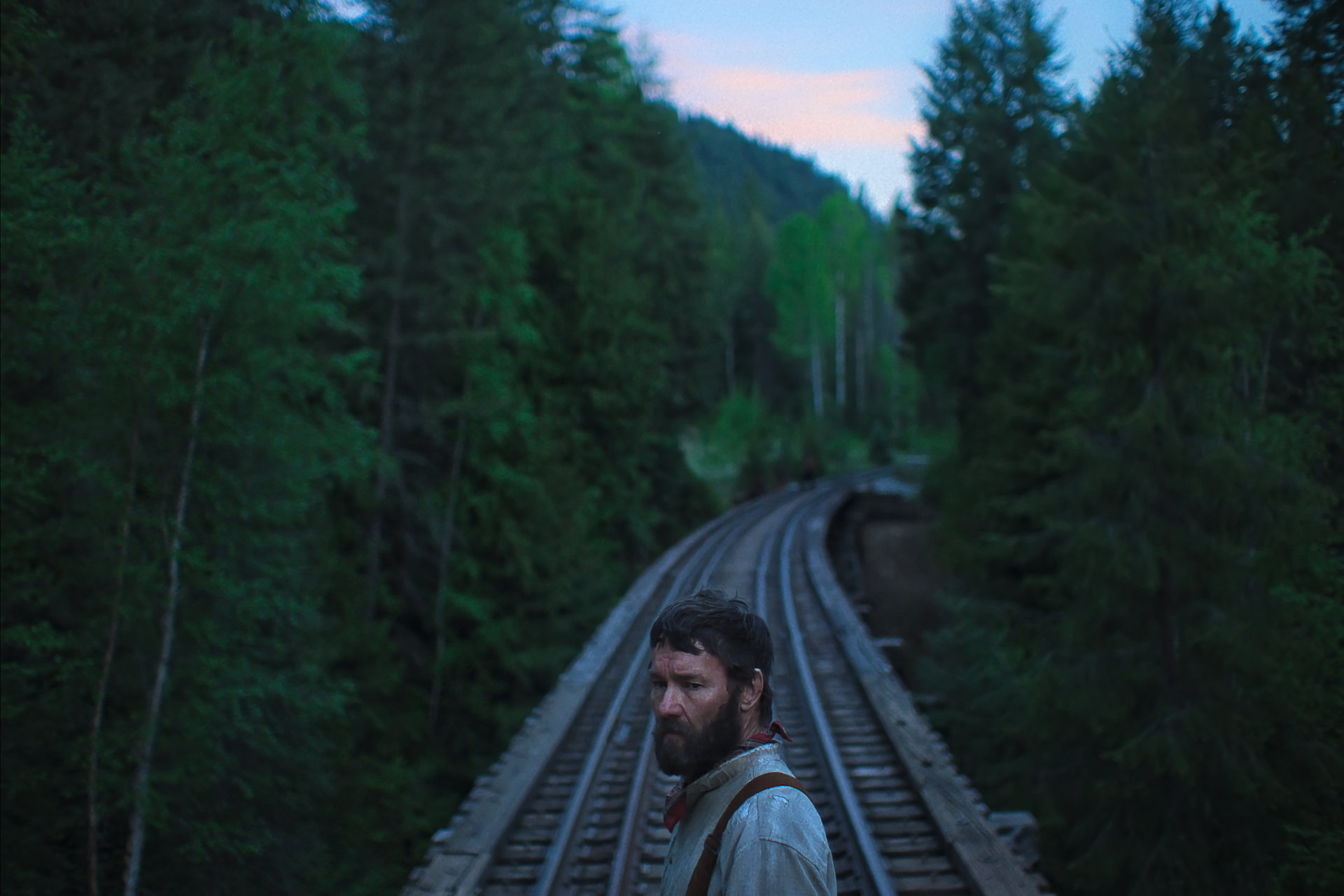
Adapted from Denis Johnson’s novella by Bentley and co-writer Greg Kwedar, Train Dreams covers the life and times of Robert Grainier (Edgerton), who begins the film as a logger, building railroads out in the wilds of the Pacific Northwest around the time of World War I, and ends it as a pseudo-hermit, haunting a cabin in the remote forest aside from trips to Spokane on the rails he once built. His work laying tracks, Will Patton’s narration tells us, was the biggest regret he’d have in his lifetime, and that thought first entered his head when a group of other loggers tossed a Chinese co-worker – a man Grainier spent months working next to – off of a bridge they’d just built, hopped up on the moment’s anti-Chinese, anti-immigrant sentiment, and angry that the man might have stolen something. The man’s ghost would come to him over the years, his haunted expression reminding Grainier of his own cowardice, of how he just stood by and let this happen, and he comes to think he’s been cursed.
You’d think the same if what happened to Grainier and the idyllic pastoral life he and his wife, Gladys (Felicity Jones), created out in the forest, on the flatlands next to a riverbank. From their first meeting, they were a great, complementary pair: She was effervescent, he reserved, both of them committed to the idea of living in their own little Eden, raising their little girl. They built up their cabin soon after they got married – in fact, part of their courtship was walking through exactly how they’d build it on their acre – and the curse seemed to disappear when he was with them there. Grainier tried to get out of the logging business by working odd jobs in town, but the money proved to be too much of an issue, and he went back into the woods with another crew. It’d be one of his last times out with a saw. When he got back, his forest – his Promised Land – was ablaze, his wife and daughter missing. What then begins as a temporary vigil waiting on the scorched land transforms into a kind of mission: he will stay there and wait for them, just in case, in a replica of their home he builds himself. Some would call it delusion, others devotion. To Grainier, it’s just what he should do.
Beyond Edgerton, Bentley’s astonishing command of tone is the film’s other magnificent feature. He endows Train Dreams with a sense of the whispered homespun storytelling that one might hear around a campfire after the bawdy tales and ghost stories have been exhausted and everyone’s had just a little too much to drink. Not enough to get punchy, that is, but they’ve drunk enough to get melancholic. There are many striking characters littering the frames of the film – a gospel-preaching logger, played by Paul Schnieder, who meets his end in a surprisingly funny fashion; William H. Macy puts in excellent work as Arn, Grainier’s only true friend out on his jobs, who brings folksy intelligence and humor to their moments together; Nathaniel Arcand as a shopkeeper who becomes Grainier’s quiet, supportive pal in the town near his home; and Kerry Condon as a Forest Service fire-watcher, who discusses loss with Grainier atop her tower over tea, providing a greater insight into his character through her mirrored experience. The vignettes are beautiful in their brevity, but the focus never leaves Edgerton. It’s his soulful eyes taking in these folks, almost too overcome with the moment to say anything.
For many of my friends and fellow critics, Andrew Dominik’s The Assassination of Jesse James by the Coward Robert Ford has been the operative comparison for what Bentley has made with this, and I can see it. It has a similar stillness and patience, which is fascinating given that it’s nearly a full hour shorter, and makes lush use of the wooded landscape of Washington state, much as Dominik’s brought out the best of their Kansas City. They’re both meditations on the end of an archetypal American ideal – the gunslinger, the man-of-the-woods hermit – who were irreplaceable as cultural figures (though one accumulated fame and fortune, and our man here most definitely does not). Each film boasts brilliant narration that lends its lead characters an extra depth, directly violating the “show, don’t tell” rule, yet somehow making their protagonists’ distant gazes richer and adding humanity to their enigmatic natures. It’s this last bit that makes the comparison feel so right – Train Dreams could be considered that opening scene writ large.
Yet, as much as I understand and respect their analysis, I think it sells both films short. To say nothing of the complex web of characters and emotions Dominik weaves, Jesse James uses that opening sequence to craft a mythopoetic figure that Brad Pitt’s character can’t and won’t ever live up to, romancing us in the same way the dime novels did to Casey Affleck. Behold the man, it tells us, as we contemplate the back of his neck as he adjusts the picture frame. Bentley uses similar words, but he substitutes the “the” for “this.” Behold this man, a forgotten figure who, like the rest of us, contains much more beauty than we’re ever able to understand or express through our own imperfect means. It’s why, when Edgerton stares into the distance, contemplating some unknown sight on the horizon, we’re immersed in his feeling rather than distant observers. It’s sublime, in the literary sense of the word: Enlivened by the details of the natural world, aware of just how small we are, of how little our lives really matter in the grand scheme of our ecosystems. Yet that just makes it all the more precious, doesn’t it?