
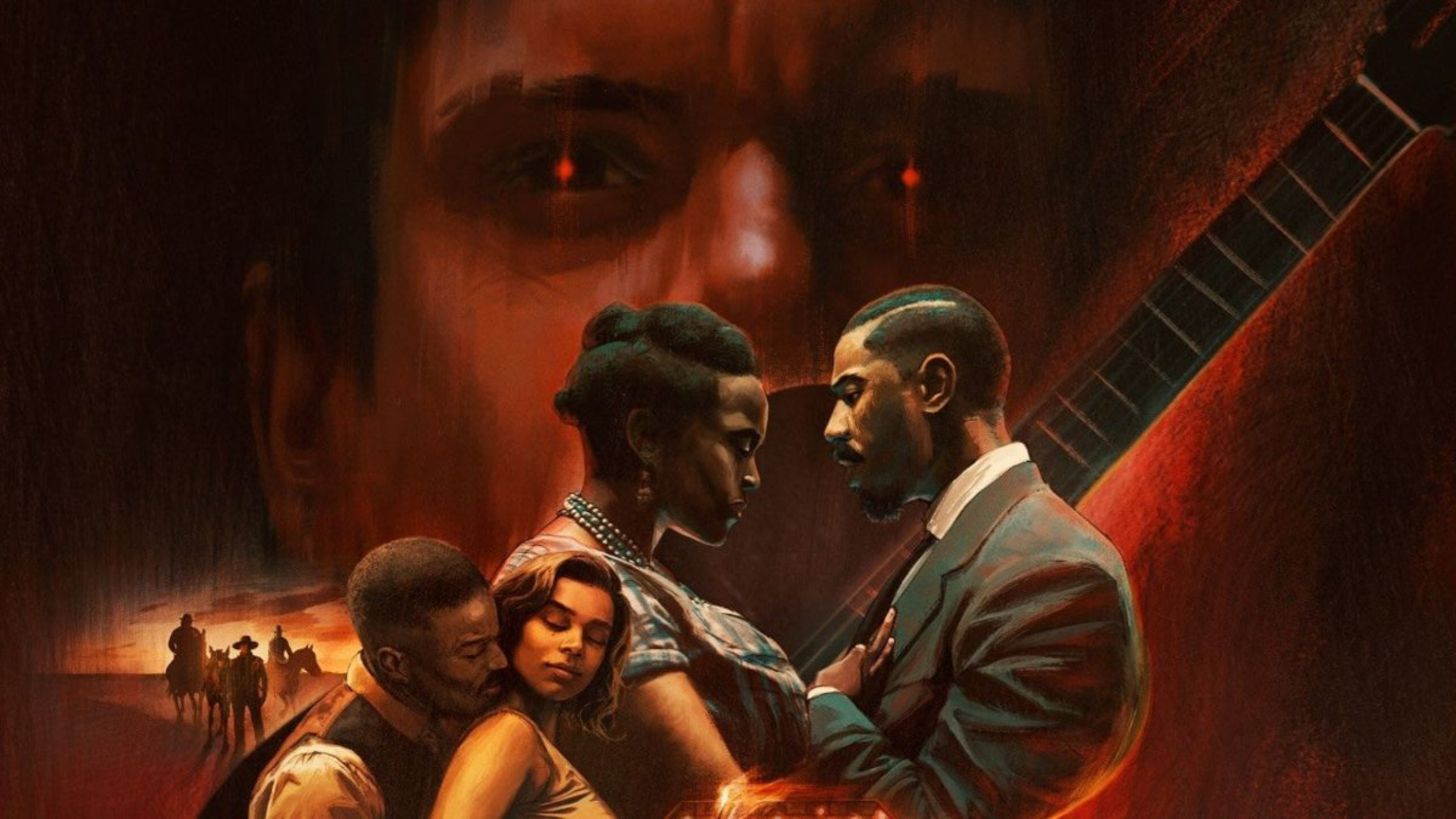
Here’s a new trend: The first movie a director makes after leaving or taking a sabbatical from Marvel will be interesting. I hate to begin any non-MCU review discussing anything relating to Kevin Feige, but the pattern stands. It might not be good (for the eight people who watched the Russo’s mauling of Nico Walker’s Cherry, we’ll never forget the shot taken from inside Tom Holland’s asshole), it might be great (James Gunn parlaying his success with the Guardians movies to make a big-budget Troma’s War in the guise of The Suicide Squad); but whatever emerges from a creative mind cooped up inside the confines of family-friendly entertainment will be worth paying attention to. Shane Black made The Predator, Taika Waititi finally tackled Jojo Rabbit, Ryan Fleck and Anna Boden did Freaky Tales, John Watts had Wolfs, and Chloe Zhao would have had Nomadland if the pandemic hadn’t done the great release-date shuffle. Journeymen (Alan Taylor, I’m looking at you) or pre-acquisition directors need not apply — this is how Disney fulfills its end of the Faustian bargain that the Mouse offers its new auteur-pedigree talent. With the notable exception of the Russos, those who escape the Disney bubble have a better track record. There’s Gunn, Watts, Fleck/Boden, and now Ryan Coogler, who decamped to Warner Bros. to make his latest feature, Sinners. Boy howdy, what an addition to that lineup this movie is. Coogler cooked up some top-shelf entertainment for us to go along with Easter brunch.
Sinners bears many of the hallmarks of a traditional Coogler picture. Michael B. Jordan is front-and-center, Ludwig Göransson is back for the score, the action scenes work wonderfully, and at the core, there’s a celebration of Black life and culture which endures and thrives even when persecuted by the Good Ol’ Boys holding the levers of power. His focus here is on the blues, as the art was before it got appropriated wholesale by a generation of boomer dads hitting each syllable in the word “margarita” like it were a heavy bag. Yet the blues was more than just the music; it was an entire way of life, as shown by all the elements that must come together for one Mississippi Delta juke joint to operate.
There’s the location, secured through tense negotiations that the Smokestack brothers (Jordan’s so nice here, you get him twice) enter into with the local gentry to buy an old abandoned mill. There’s the fried catfish cooked up by Stack’s old flame Annie (Wunmi Mosaku), who spends her days otherwise cooking up folk cures free of charge while practicing hoodoo, only dragged back into it by her former partner at his request. There are the signs, handcrafted by Grace (Li Jun Li), who, along with her husband, owns the general stores — one white, one black — on Main Street. Then there’s the talent, with Delta Slim (the king Delroy Lindo) on the keys and the brothers’ young cousin Sammie (Miles Caton) on the steel guitar.
Add Cornbread (Omar Benson Miller), the door man; Mary (Hailee Steinfeld), who was Smoke’s girl once before the brothers sent her down to Arkansas for a better life where she could pass for white; and a near-endless supply of liquor and beer that the brothers brought back with them from their travels in Chicago, and you’ve got a moment only possible in the Depression-era Dirty South, one of many whose influence will inform more culture than anybody there could even imagine at the time. Yet no one’s ignoring the darker side: Sure, there’s loaded dice at the table and fistfights, but any moment, the Klan could march on over, or some of the boys from the outfits that the Smokestack brothers left behind up North might knock on the door looking for a pound of flesh. It’s a fleeting, precarious moment, the joy balanced with the pain, only a tilt away from careening into disaster. Of course, everybody’s horned up in a place like that: Sinners is all about dirty blues of Bo Carter, Harry Roy, and Ora Alexander, and the movie’s as sexually aggressive as it is funny, much like Lucille Bogan’s “Shave ‘Em Dry.” Seriously, there are more laughs per minute in this than in a typical marquee action-horror picture, with each joke helping to expand our perception of the characters. That doesn’t mean they’re flippant fools, as, when trouble finally comes a-strumming on its old banjo, Coogler and company deftly avoid all of the cliches about stupid horror protagonists, which is a genuinely astonishing feat.
That trouble takes shape in the form of Remmick (Jack O’Connell), who proves that Riverdance really was the work of Satan’s minions. We first meet him fleeing from a group of Native American trackers, cooking alive in the sun, running towards a cabin home to a couple of rednecks (one of the dudes from July Talk and Lola Kirke). He offers them gold if they let him in to hide out, and they oblige. A few hours later, this vampire has enough familiars for a three-piece bluegrass band, which he seizes upon, smelling another culture to assimilate like he’s Locutus of Borg. Remmick’s as much of a bloodsucker as he is a culture vulture, looking for new experiences and stories in his victims, who become anonymized versions of their worst selves when put under his thrall. Call him a major label or a big five studio or white culture: the man sees authenticity in front of him and can’t help but sap every ounce of life out of it, promising equality — his troupe of familiars is diverse, if nothing else — when what he means is the sameness that comes with servitude. Our characters figure out what they’re dealing with, but not after some bad luck and tragedy: All they can do is fight back and do their best not to get turned into lunch.
It turns out that having two veterans of the trenches turned mob soldiers on your side is good for self-defense, though. Jordan is in peak form here, alternating between charm and wit in the form of Smoke and a soulful action-hero badassery as Stack. He has an action sequence so good here that I will not spoil it, but you better bet if you see this in a packed house that people will be straight cheering once it happens. Coogler did not take the Marvel approach to action when he left Disney (and thank god for that), but he retained his skill with large ensembles. Each performer gets at least ten moments to shine (even poor Cornbread gets one of the film’s best gags when he goes out to take a leak), unless they’re with Lindo, who walks away with every single scene he’s in. The real praise should go to Caton, though. Sammie’s storyline is a classic blues one: The son of a preacher man who wants him to put down that guitar and get away from a life of sin is confronted with what that sin looks like. He’s a Robert Johnson analogue who is at war with the devil rather than his business partner, and he has plenty of good reasons to give up the ghost and flee to his father’s house. He’s the film’s anchor, and he does a fantastic job of giving the movie some practical weight beyond just being top-flight entertainment. Hell, his resolution is one of the best things you’ll see in cinema all year, and it’s only April.
Let’s return to the Robert Johnson comparison, though. You might recall he was actually floating around on a roll-top desk in the Coens’ O Brother, Where Art Thou?, which feels like the country and bluegrass equivalent to what Sinners is for the blues. Substitute Homer for Hawks’ Rio Bravo and make Johnson the story’s focus rather than a sideways acknowledgement of Deep South lore, and you’d wind up with what Coogler’s made. They complement each other nicely, though it is pretty funny to imagine that Coogler has some beef with George Clooney, causing him to make a movie five times as good as From Dusk till Dawn and one that might become nearly as much of a cultural phenomenon as O Brother was back in the early ‘00s, where that soundtrack was practically inescapable down south.
Sinners is a great movie, top-shelf entertainment to be poured in special celebratory moments, and it’s so exciting to see that studio life hasn’t crushed Coogler’s ability or imagination. Just look at the sweeping sequence in the middle of the film, in which phantoms of cultures past and present inhabit the juke during one of Sammie’s numbers on the guitar, the camera careening across the dance floor as the song reaches its apex and the roof literally and figuratively catches on fire. That’s some real good shit right there.