
Editor’s Note: Vanyaland film editor Nick Johnston is back in Canada this week covering the 50th Toronto International Film Festival. And as usual, we wish we were up there with him! Check out our continuing 2025 coverage, get rolling with our official curtain-raiser, and revisit the complete Vanyaland coverage archives from past TIFF editions.
Usually, when one hears sniffling during a press and industry screening at the midpoint of any given film festival (and doubly so if it’s Sundance), you can attribute it to whatever brand of cold is spreading that year. This isn’t to say that critics are a wholly immovable bunch, though we do get a reputation for being the saltiest motherfuckers that ever lived, which, frankly, we often earn whether we intend to or not. It’s just that when you see so much, you get desensitized to all manner of tragedies, and only those with John Boehner-style loose tear ducts let them flow at the slightest provocation. The feeling becomes intellectualized to the point where you’re more focused on how something is making you feel rather than the feeling itself. However, there are exceptions to this, hallowed, strange moments in which you hear the rustling of bags — writers and buyers, prepped for a long day out away from their hotel or Airbnb, searching for Kleenex they brought along — and perhaps a few choked sobs as well. The P&I for Chloe Zhao’s Hamnet was one of those occasions. There wasn’t a dry eye in the house.
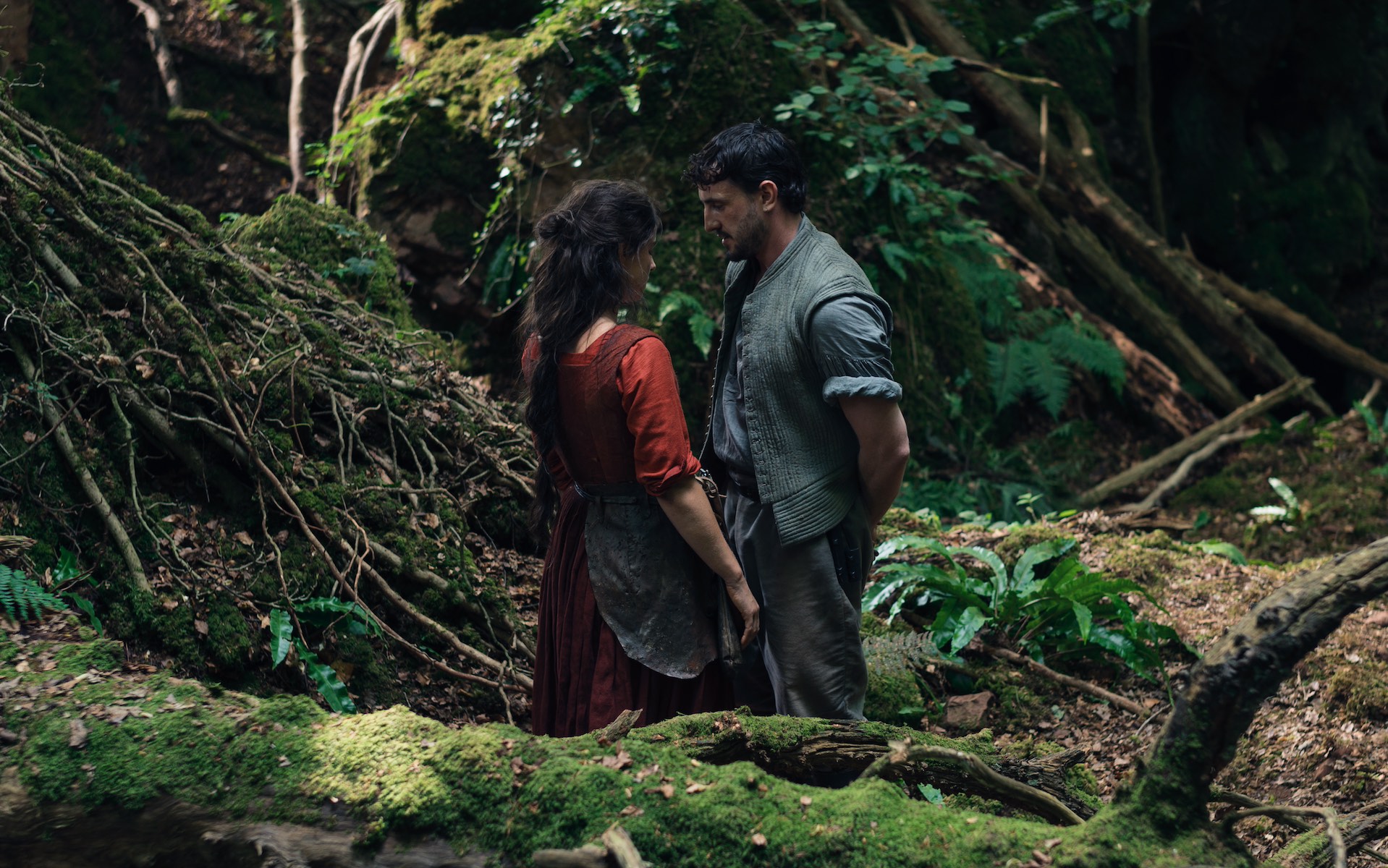
Based on the novel by Maggie O’Farrell, who co-wrote the screenplay with Zhao, Hamnet could have also been titled Hamlet, as an epigraph-like title card informs us that these two names were essentially interchangeable in Elizabethan English. We begin years before those words, words, words were ever breathed on the stage at the Globe, back when Anne Shakespeare was Agnes Hathaway (Jessie Buckley), a yeoman’s daughter who trained hawks in the woods near Shottery, where she lived with her brother (Joe Alwyn), stepmother, and an assortment of younger half-brothers and half-sisters. She has a connection to the land around her, honed by her dearly departed mother through not-quite-magic, and has a strange sixth sense: if she touches the space between a person’s thumb and pointer finger, and closes her eyes, she can see into that person’s soul.
When the town’s new Latin tutor, the well-off son of a glover, begins to awkwardly court her, Agnes resists. She knows his type, after all, and he’s too young and fresh to know what he’s doing. But when she holds his hand, she sees a vastness inside of Will Shakespeare (Paul Mescal) that she can’t quite quantify. His imagination blows her away, prompting her to look a little deeper. They fall deeply in love with one another, and soon enough, she’s pregnant. Over the objections of Shakespeare’s mother (Emily Watson) and father (David Wilmot), they marry. Unsatisfied with his life as a glover, Agnes and her brother encourage Will to go to London and try his hand at costuming for the theatre. He returns as a playwright. They have three children: First, a daughter, Susanna (Bodhi Rae Breathnach), and then a set of fraternal twins, Hamnet (Jacobi Jupe) and Judith (Olivia Lynes). The latter pair causes Agnes quite a bit of consternation: She had a vision of two children being at her bedside when she dies, so the fact that she has three bodes ill.
Still, she puts it out of her mind and celebrates her children — how lucky they are in many ways, and how fortunate she and Will are to have a child, specifically, like Hamnet. The little boy hates how far away his dad often is, but he idolizes him and their moments of tenderness together. Perhaps he’ll join him on the stage one day. But while Will’s away on business in London, tragedy strikes: plague is spreading back home, and Judith comes down with it. Agnes begins a vigil, using all of the practical knowledge she learned from her own mother to keep her daughter alive, while Hamnet considers his options. He and his sister are used to fooling their father (believing that they’re identical twins, they often dress up in each other’s clothes) — could he swap places with her when Death comes to take her away? His choice, his illness, and his eventual death will nearly destroy his parents, but it will, in a strange way, ensure his immortality as the inspiration for one of literature’s greatest works.
Much of this story’s success can be attributed to its refusal to treat its characters as infallible historical figures or conform to the dimensions of modern-day scholarship (Hi, Ann Lee!). This is simply because there’s not a ton we know about the actual Anne Hathaway, to the point that there’s a still-brewing dispute among historians and literary scholars about whether her name was Anne or, as outlined in her father’s will, Agnes. As such, Hamnet’s leads feel breathtakingly modern, with the revisionist aims of O’Farrell’s novel – imagining a history and personality for Agnes and, even crazier, suggesting that Shakespeare might have actually loved his wife (I do think that entire generations of literature professors may have imprinted feelings towards their unhappy marriages upon the Bard’s without any source to suggest otherwise) – landing as intended. Barring the occasional flight of forest-magic fancy (and that was more common than you’d think in that day), this is a historically plausible scenario that neither doubts his brilliance or suggests that he was merely the figurehead for someone else’s talent while acknowledging that someone probably had to push him to leave for London and that events in his life might have inspired more than the Sonnets.
There’s really not much I can say about Buckley and Mescal other than to suggest that they give two of the most accomplished and moving performances of the decade here. They’re brilliantly cast, complementing each other’s strengths, and you buy the depth of their romance and, by extension, the abyssal nature of their grief. Mescal is just perfect – he’s charming, slightly strange, tortured by his genius, full of guilt for his absences, and embodies how Farrell’s Shakespeare reads. He gives, for my money, the best recitation of the “To be or not to be” soliloquy yet put to film in a moment that imagines a near-suicidal Will contemplating whether or not to throw himself into the Thames and let the currents take him away. In close-up, he whispers the words we’re all so familiar with in their proper context: a hushed evaluation of whether or not it is worth it to endure the torture that each successive minute without his son brings. Likewise, his final scenes bring new meaning to a pivotal scene early on in the play, and the costuming and make-up are as aesthetically gorgeous as Mescal’s interpretation of the words.
For whatever reason, I never caught the Buckley bug back when it first started spreading, circa Beast and I’m Thinking of Ending Things, but her work here finally let me into how fearless she is as a performer. Her primal grief – the scream she lets out when she discovers the switch-up is absolutely blood-curdling – will be the flashy moment ready for the Oscar reel, but it’s her work in the final scenes that is, to me, utterly transformative. She’s asked to enter a totally foreign environment and process her husband’s grief as metaphor, and as we watch her come to understand what she’s watching, she reacts in unexpected and profound ways. They never feel like stage directions or overly writerly, coming off as wholly spontaneous reactions to what’s in front of her. The way she maintains this suspension of disbelief in a scene that would fall flat in even slightly less qualified hands is astounding and deserves nothing less than italicized superlatives.
The same can be said for Zhao, who has made one hell of a comeback after the disaster that was Eternals, proving that the bastards at Marvel couldn’t keep the director of rich works like The Rider and Nomadland down. Her direction is patient and still, never distracting from the moment while being formally impressive. The careful treatment of the pastoral setting (the film is gorgeously lensed by Zone of Interest cinematographer Łukasz Żal) and the rich performances result in a feature that resembles what might happen if modern-day Malick decided to ditch the steadicam and pick up a tripod. It’s lush and deeply poetic — her vision is tinged with a literary fire that makes it all the more devastating when the supernatural elements are introduced (it’s not “fantasy,” or whatever — it’s just an acknowledgment of a character’s belief system through their interactions with the sublime).
Trust me, Zhao’s first true lapse into metaphor, at the moment of Hamnet’s passing, is as elegant as it is utterly fucking devastating. That was the moment that got me, with the icy dissociative wall of separation between feeling and analysis (“Oh, wait, am I crying?”) melting into a wholly immersive weeping, with its tears that refused to stop until 20 minutes after the credits. It’s the hardest I’ve cried in a movie since at least 2011, when The Tree of Life hit theaters, and it’s the kind of thing that could make a child actor cry on cue. That’s the kind of quality you’re dealing with here – a literary yet fully cinematic, elegant yet raw masterpiece, anchored by two of the best actors of their generation. You can’t write comeback stories as good as Zhao’s without it seeming unbelievable — she earned every tear shed by that audience, and I hope she knows it.