
Calling all Oklahoma! haters — Richard Linklater’s Blue Moon is partially the feature-length excoriation of the plague that Rodgers and Hammerstein released on in 1942, one which soon spread to high school theater auditoriums and infected an entire generation of the Broadway-bound post-Ziegfeld. It is wonderfully out of step with the slow-burn obsession that certain filmmakers and showrunners have with the subversion (and unwitting reinforcement) of its iconography*. Here, Charlie Kaufman — this is a movie properly about disillusionment and failure, which works without having to flash-fry Robert Zemeckis with a burn measured in megatons. I don’t think it’s unfairly applied, either, with what it did to replace the words “Rodgers and Hart” with “Rodgers and Hammerstein.” The latter pair created inimitable works suffused with charm and propriety, being an often well-intentioned collaboration that cloyed its way into the hearts of millions. In the process they created the modern Broadway stage, iterating on Show Boat, and refined the image of an America (and, later, a world) that never really existed. Rodgers and Hart, on the other hand, reflected their audience as they were: a beautiful, bitter, bitchy, brassy, blithesome, bizarre boffola bummer, in which things got so bad that all you could really do was laugh before you started crying. Such were the old time rags, crying jags concealed with a lacerating wit.
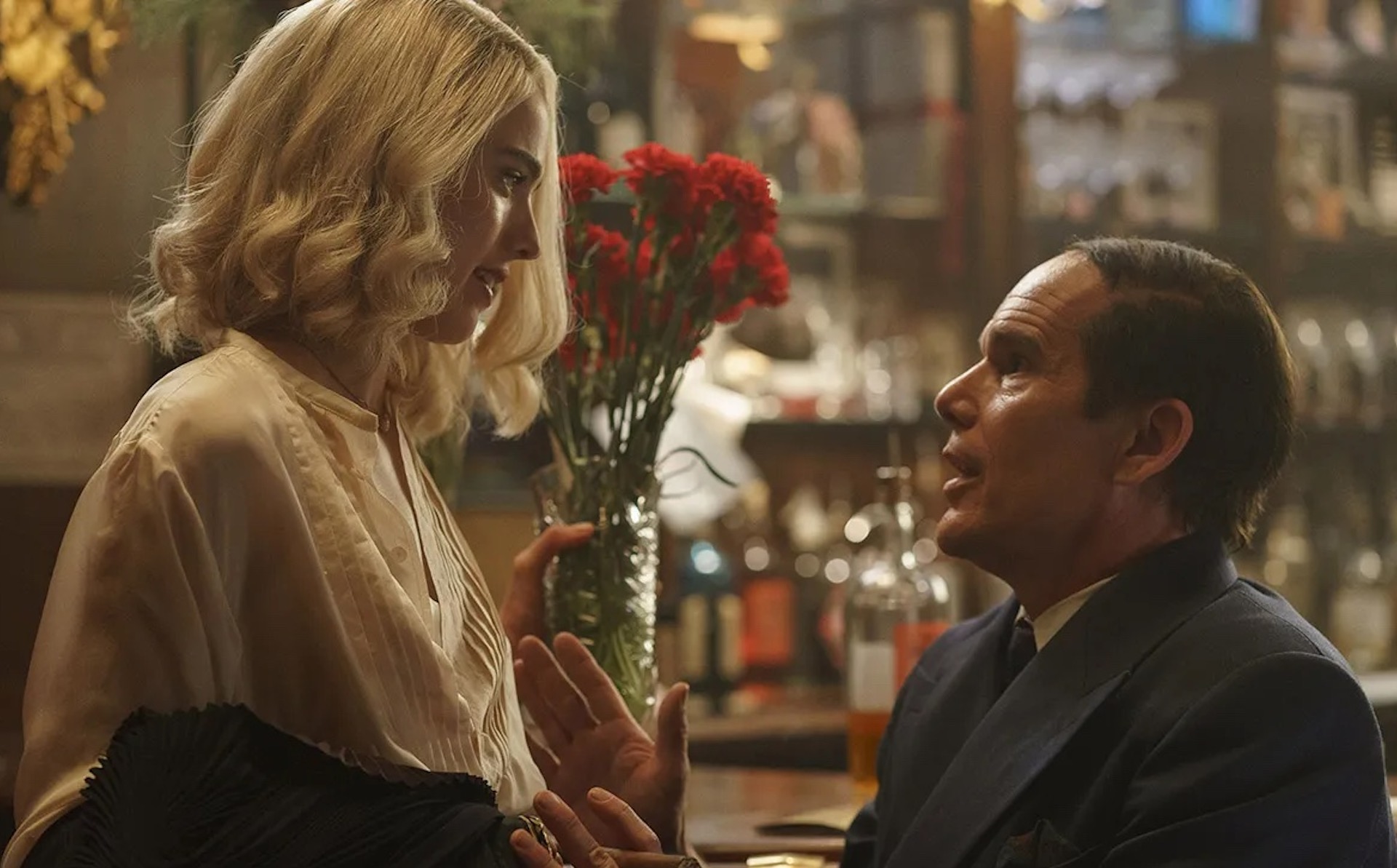
Lorenz Hart (Ethan Hawke) has plenty to sob about but, much like his tunes, he’d never let you know it. Short, balding, and in need of a stiff drink even though he swears he’s staying on the wagon, he ventures into Sardi’s from the streets of wartime Manhattan irritated, envious and yet strangely hopeful. He’s just walked out of Oklahoma’s Broadway debut, and has chills — not in the sense that one gets when they’ve been moved by a stirring, emotional masterwork, but the one that’s best described as “someone stepping on one’s grave.” He’s not deluded or stupid — he knows that Richard Rodgers (Andrew Scott), his former songwriting partner, has composed a bonafide hit, and that his career is essentially cooked. Put a fork in the remnants of Vaudeville, they’re well-done and charred. The bar’s as much of a sanctuary as it is a place for him to camp out and, while he waits for the musical’s after party to start, he shoots the shit with a friendly bartender (Bobby Canavale) and ropes in the regulars in a freeform call-and-response dripping with acrid wit. He’s got two purposes in being there: first, he wants to get back in good graces with his old partner Rodgers; second, he wants to impress a muchyounger Yale student (Margaret Qualley) whom he’s become enamored with by the big bright lights of his influence and connections, even as they dim into a kind of pathos-laden pity.
Never mind that he’s queer (in the undefinable sense of fluid heterodox sexuality before we figured out how to categorize it) and the girl knows it, or that she’s not likely to be impressed by the glitz and glamor (her mother, after all, is a member of the Guild, so she’s used to premieres) or the first-edition copy of Of Human Bondage he’s brought her: the important thing is that she’s on his turf and he’s fully enraptured, full of instantly-empathetic longing for love. He both rightly understands his home-field advantage and underestimates its impact. Sardi’s is one of the few places in his orbit where he’s a master of the universe. He’s recognizable to patrons large — EB White, who sits scratching away at a notepad in a corner booth, nursing a martini — and small, including a GI on leave who has some skills behind the piano, accompanying Hart’s commentary with selections from his songbook. He’s nervous, and like any good showman, he plunges into overdrive, wowing the patrons and even himself with his wit. It’s as if he knows that this is his last shot at something resembling a happy ending — in several months, he’ll be lying soaked in a gutter with fluid-filled lungs, incoherent, intoxicated, and suffering from the pneumonia that would ultimately claim his life. But that’s to come, and this night’s a showcase for all the grace of a falling star, one that’s still shooting across the night sky with fuel left to burn. Play a stanza of “Blue Moon,” and he’ll tell you about the movie it was written for, and he’ll tell you how much he hates you that song* (in exaggerated fashion, of course). The man is in his element, the guard has not yet changed. It is his final watch over his hallowed, gin-soaked home, and he’s ready to make it messy and spectacular.
As you might expect, Hawke is ferociously brilliant as Hart, and if you’d like to describe it as a “tour de force” or whatever other example from the Great American Book of Critical Cliches, feel free to do so. A picture of this performance should be on the goddamned dust jacket. His timing is impeccable, with the placement of his bon mots driving the rhythm of the conversation; his accentuation of Hart’s strange physiology works better than any of Linklater’s in-camera attempts to portray it; and he has a clear understanding of the emotion animating all of the character’s anxieties and desperation. He’s afraid of his irrelevance as much as he’s scared of remaining unloved, the social death being, ultimately, worse than the real one. Hawke is nearly unparalleled in authentically capturing the stress choking a character and the veneers they put up to mask it, but it’s rarely applied in a fashion this potent, ensuring every other performer on screen gets the “thankless” descriptor when one sits down to describe their still-ample contributions to the film. Scott is exceptionally well-cast, complimenting Hawke’s single-minded dynamism by maintaining an air of ambiguity, where one’s unsure where the frustrated disappointment and genuine admiration for his former partner begins. Canavale is the perfect comedic compliment with his brassy exterior and unexpected grace, and Qualley maintains an ethereal presence, the fictional manifestation of a thousand of Hart’s real-life failed relationships, women and men who he could only admire from a distance, yearning.
There are a few aspects of Blue Moon that will draw undeserved ire, with the most obvious being the presence of cute, fictional nods to how Hart might have influenced those around him. These include White, to whom he gives the name “Stuart” to when describing a mouse he sees in his kitchen; Yale undergraduate George Roy Hill, whom he tells to stick to stories about friendship; and a young Stephen Sondheim, who Hart wants to punt out of a window following some twerpy commentary from the kid. These feel tinny in the moment — one half expects him to bust out with “Johnny B. Goode” on the piano with Papa Berry taking notes on a Sardi’s cocktail napkin — but feel poignant when placed in the context of the character’s psyche. Here he is, consumed by his failures, watching his partner have the best day of his professional life, and his idle conversation goes on to influence American culture more than he’ll ever know. Of course we know that he’ll never be around for Butch Cassidy and the Sundance Kid or Merrily We Roll, but this myopia is a key ingredient of our experience of narrative tragedy.
The other is the specter of the stage. With any single-location drama centered around conversation, it’s not beyond the pale to imagine complaints that Linklater’s direction is stagey. When compared to Nouvelle Vague, a much flashier film of his that may very well be playing down the hall at the arthouse multiplex when you go see this, Blue Moon might bear the stink of dinner theater to those who like their narrative mediums distinctly separated by concrete barriers. There are two rebuttals to this: first, it’s a film about theater which directly places itself in opposition to a stagebound spectacle like Oklahoma!, and so the quiet route — the one that emulates the hush of the stage rather than its bombast — is, in fact, the most appropriate route. Second, “stagey-ness” often describes stilted, flat direction, but it is usually used to describe failed intimacy rather than matters of blocking and framing. On this count, I couldn’t disagree more with this paper tiger-like critic that I’ve invented for rhetorical purposes. When you have a performance this enrapturing, paired with writing this strong, why pirouette and draw the audience away from the true magic?
Linklater succeeds here because of how close he brings us to this strange, lovely character, as if we were perched two or three barstools away, inevitably drawn into discussions of Casablanca and that latest article of White’s in the New Yorker, regaled and amazed by anecdotes which can only be told by someone who considers themselves totally washed up and a has-been, desperate to see if he still has the goods that got him famous in the first place. If only he could listen to himself with some amount of distance from his problems, he’d see that he does. It’s in the way he talks, in the way he evokes a mood with just a few well-places descriptors, in his eternally self-effacing humor, as insightful as it is misapplied. Sure, you could find plenty of reasons to hate him (he is, after all, a nightmare to work with), but it’s hard not to see Hart as a man who writes a song like “My Funny Valentine” as its subject’s fantasy rather than the insult-laden roast it’s occasionally described as by the attractive. If only someone could have told him he didn’t need to change one hair for someone to be worthy of love, perhaps he could have sorted the signal — quit drinking — from the noise of rejection-stung self-criticism echoing through his head. It’s a bitter, beautiful tragedy from which he can’t extricate himself, in which his lust for life and love goes unfulfilled, washed down the gutter, only a tune remaining. Isn’t it romantic?
* My personal favorite cover of that standard is Elvis’ melancholic variation, a low-fi outtake included as an extra on reissues of his self-titled first record.
** Seriously, guys, go the True Detective route and make recappers and reviewers sing for their supper. Or at least have them googling who the hell Richard Chalmers is.