
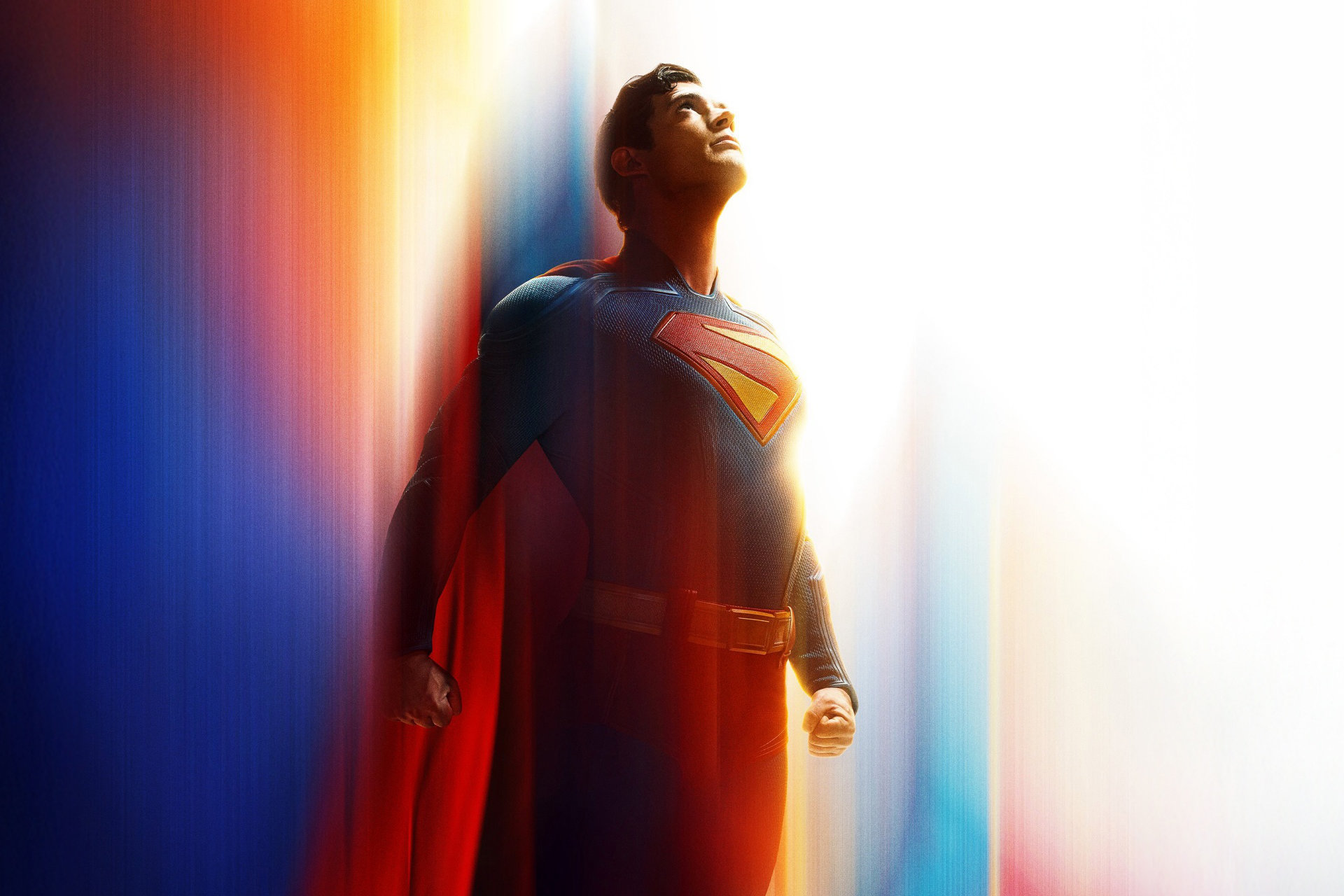
What you may first notice about James Gunn’s Superman is that it doesn’t exactly have a first act. A la Matt Reeves’ The Batman, it begins with the Man of Steel (David Corenswet) just three years into his career, in a universe in which he’s not the first superhero (that happened centuries ago, according to Gunn’s new timeline), and he’s feeling the pain of perfection. He’s just gotten his ass kicked by some power-suited representative of a small Eastern European country whose invasion of a smaller nation he’d thwarted a few weeks ago. He crash-lands into an icy plain, lays broken and battered in the middle of Antarctica, and relies on his super dog Krypto to drag him to the safety of his Fortress of Solitude, where a cadre of Robo-Servants help fix him up. Lex Luthor (Nicholas Hoult), mad scientist and CEO, is, of course, behind all of this, and for the first half of the feature, we watch as he absolutely dabs on the Kryptonian. His girlfriend, Lois Lane (Rachel Brosnahan), has major ethical issues with how he’s conducting his good works, the other superheroes in town are assholes, and a major revelation about his life throws everything into complete chaos. This is odd, a major storytelling departure given the nature of the genre (aren’t we supposed to see him… be super?), made even more bizarre in the context of what this feature is supposed to represent to the newly-christened DC Studios (a new era, yadda yadda), and made downright weird when you remember how the director made his first true-blue success in the cape-and-tights field.
The first 20 minutes of Gunn’s Guardians of the Galaxy are a masterclass in how to hook an audience on a seemingly daft concept. You have an emotional hook (a kid watches his mom die), an arc-inciting incident (said New World Pictures-like aliens abduct child), and an immediate tone-switch appeal to the audience: The now-swole formerly-chubby guy from Parks and Rec beating Indiana Jones traps while rocking out to Redbone on his Walkman. It’s important (and now occasionally difficult) to remember that Gunn had the least-steady of all the Marvel properties yet brought to the screen, as the team were, to say it politely, D-listers with the kind of inconsistent characterization and relative anonymity that accompanies a status like that. If a quizmaster asked “Who is Groot?” at a bar trivia night before 2014, there was a not-insignificant chance they’d get run out of the pub for deliberately stacking the deck against the teams.
Yet we all know how that first Guardians turned out – a runaway hit that spawned two additional features, a TV series, a holiday special, and a David Hasselhoff single, made Gunn, a Troma alumni best known for surprisingly insightful gross-out horror, into a nerd savior, and convinced Kevin Feige that he could lay golden eggs with any dumb Marvel property. People have accused Feige of chasing that Endgame feeling with everything they released after 2019, but I think he’s been chasing that Guardians feeling for much, much longer, even more so than Iron Man. It was proof of his invincibility, Gunn his standard bearer. The divorce was messy, and, after the last Guardians movie, Gunn decided to try his hand at beating Feige at his own game.
Such a task requires throwing the playbook into the pocket-dimension portal. This is why Superman feels so drastically different from the usual genre fare, which can oscillate between poles of thrilling mythopoetry at its finest and capeshit at its dullest and most disposable. It is meant to propose an alternative to the Average Avenger Assembly Line, replacing the well-worn bits of the genre with something less polished and secure in its success but more, well, authentic and inspired. Most importantly, it is meant to sell you, like the first Iron Man, on the idea that this might turn out to be something much bigger without turning the whole feature into an overly long trailer for projects that might not even get greenlit, without drawing major attention to the bits and pieces of universe-building scattered all throughout.
Hence the shape this Superman takes: The film itself is the hook, the opening sentence of a grand elevator pitch for a world of DC heroes that resemble their comic-book counterparts, warts and all, and the third act — the brilliantly executed dopamine-slamming payoff that hits all the right buttons and will be what the audience remembers as opposed to the early stumbles—indicates this larger project something worth investing in. I can hear the cries from those who are upset that I’m considering this extra-textual context, but it does explain the structure and provides an ethos to the larger purpose of Gunn’s endeavor. That is a wholesale reframing of Clark Kent’s character and purpose in the aftermath of Zack Snyder, and an attempt to break the iconography out of the Donner-styled trance it has been under since 1978. And it works.
Of course, large portions of the film are informed by both of those renderings, and often to great effect, much of it in the casting. Corenswet provides the perfect balance between Henry Cavill’s otherworldly stoicism and Christopher Reeve’s boy scout puckishness; Brosnahan echoes Margot Kidder as much as she does Amy Adams in Lois’s steadfastness; and Hoult redeems the idea of “Luthor as tech bro” that Jesse Eisenberg fucked up while preserving just enough of Gene Hackman’s huckster con man to make the villain slimy as opposed to merely evil. Yet Gunn elides Donner’s portentous tone and meaning-burdened iconography, knowing it’s burned into our retinas, and makes a decent case that much of what we remember enjoying about Superman: The Movie actually comes from Richard Lester’s Superman II. He bets big on the idea that people want to have fun rather than sit through a sermon, and the movie often has a screwball sensibility that’s only heightened by his choice to style the world closer to the Richard Fleischer cartoons and Grant Morrison’s contributions to the character’s canon.
This Man of Steel inhabits a broad and wacky science-fictional universe that borders on the cartoony, which is only a problem when DC employs it, for some reason. For the most part, it’s more comic-accurate than any other portrayal of the character put to screen, as long as we’re including the whole of the character’s history, Curt Swan’s genial goofiness, et al. Gunn favors a wide-screen immensity to his imagery, cognizant of the epic scale, though his choice to desaturate the color palette in a Janus Kaminski fashion is something I disagree with in theory but don’t mind in practice.
What I have always disagreed with in theory and practice is the approach articulated by Quentin Tarantino through David Carradine in Kill Bill Vol. 2, the “Clark Kent is the mask” bullshit that we all, especially Snyder, took as gospel after Superman Returns demonstrated how fully tapped-out Donner nostalgia was. Gunn makes changes to the “story” as we know it to enhance that point, and does so with a heartfelt tenderness that makes it hard to quibble with the departures too much. The Nietzschean contrarianism doesn’t work in a culture that is quite frankly well-saturated with variations of the Superman-as-asshole archetype, having overtaken the earnest years ago and now vastly outnumbering them. The problem is that this is much, much too easy, though it is the logical conclusion and the most realistic one to the problem that an idea like Superman poses. An absolutely powerful being will be absolutely corrupt, there is no such thing as free heroism, and so on and so forth.
The problem is that this overlooks the character’s essence as a fantasy and the parable’s intended meaning. Superman tales are ones in which things ultimately go right. They are, in Morrison’s words, “[stories] about a man who will never let us down.” “Man” is the operative word in that phrase – not “alien,” not “god,” not “hero” – and Gunn’s entire thesis is, essentially, that Superman is a manifestation of good human impulses rather than an alien overlord deciding what’s best for all of us. He’s an immigrant who found a home, fallible but good-intentioned, foreign but familiar, and deeply, deeply human despite all the Kryptonian DNA.
Once all these disparate threads converge in the back half of the feature, Superman becomes something special —a spectacle of genuine superheroics rather than empty punching and bashing. It is clear that Gunn has plenty of affection for Snyder’s style, too, with his speed-ramping frequently echoed here during the action sequences, but the context is changed to accompany Gunn’s vastly different thesis on what the Superman fantasy means. Snyder’s idea is that Kal-El is the ultimate manifestation of godly power, whose aloofness and inability to connect are a representation of his otherworldly strength, an alien given to us by a now-absent father whom we promptly killed and watched as he was resurrected. Gunn’s is simpler: Superman is the essence of human kindness, as shown to each of us in our most desperate moments when a helping hand descends to lift us out of the darkness. It is a power fantasy rooted in a deep sense of powerlessness, less about imagining ourselves as a grand savior but about us being worthy of rescue.
Gunn constantly emphasizes how big his (metaphorical) heart is: The one moment in which Superman flies off the handle comes when, following what may be the worst 24 hours of the Kryptonian’s life, Luthor kidnaps Krypto. He’s crushed by this, and makes a choice that puts him in a dramatic amount of danger in order to save the dog. Lois asks him why he’d do this, and he says something to the effect that little pup is out there and afraid, and he can’t stop thinking about it. He has to help. He will not, and can not, let him down. Gunn doesn’t let us down, either.