
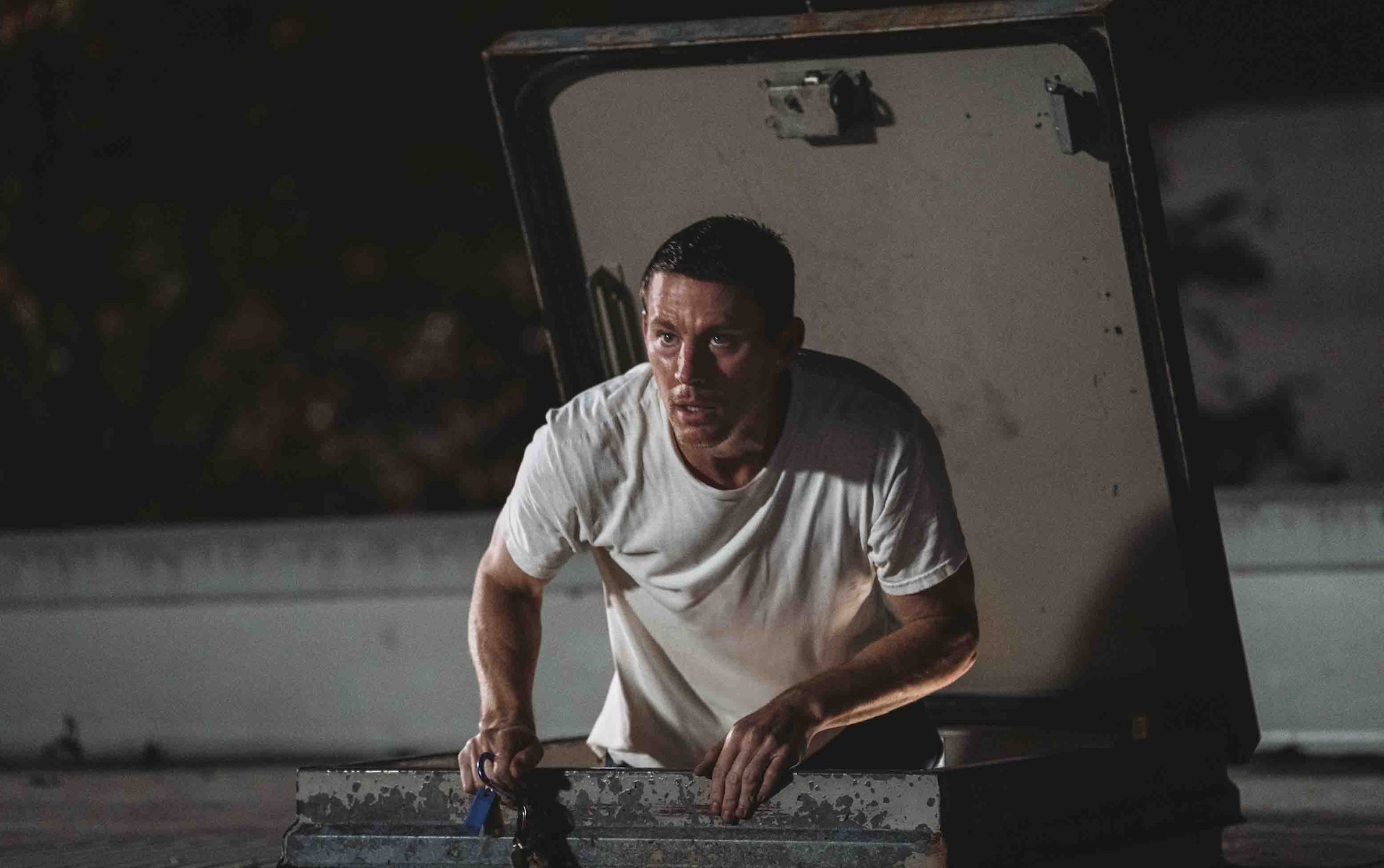
Editor’s Note: This review originally ran as part of our coverage of the 2025 Toronto International Film Festival, and today we’re re-publishing it with the film’s wider release. Check out our extensive review slate from TIFF50, revisit our official curtain-raiser, and check the complete Vanyaland coverage archives from prior editions.
Leave it to Channing Tatum to prove that people actually live in the city of Charlotte – it really isn’t just banks and struggling sports franchises! I say that with plenty of love, as a Tar Heel born and a Tar Heel bred, and that’s why Derek Cianfrance’s Roofman hit as well as it did for me. I think there’s a broader appeal than just folks with a blood feud with a neighbor over the Carolina/Duke rivalry, but color me impressed. As a work of NC-centric media, Cianfrance’s first theatrical feature in nearly a decade is probably the best since Eastbound and Down left the airwaves, and is of a similar mindset as the average Green-Hill-McBride feature, if it’s a little tamer in content. It’s also a radical departure from the director’s established tone, similar to how David Gordon Green cheered up with Pineapple Express following years of Malick-like cinema with fewer stylistic concessions and less flippancy (and don’t worry: Ryan Gosling’s not even in this one, and that means he won’t die in the first third and leave you mad as hell at the advertising). But it’s the way it uses the rich tableau of life past the Piedmont that makes Roofman stand out among a festival slate strewn with true-crime tales, and the remarkable empathy and gentleness it has for its characters.
You could use those words – gentle, empathetic — to describe Jeffery Manchester (Tatum), who is the type of gold-hearted, irresponsible person who so desperately wants responsibility that they’ll go to remarkably complex means to attain it. He feels like a disappointment, given that his military career has come to an end, his marriage hasn’t worked out, and he can’t seem to find stable work. He can’t ignore the disappointment on his young daughter’s face when she opens a birthday gift and discovers it’s not the bike she’s hoped for, but hand-me-down toys from his childhood. That day, his friend and fellow veteran, Steve (Lakeith Stanfield), points something out to him: Jeffery has a real knack for remembering details, possesses an incredible sense of creativity and invention, and the patience and follow-through to see a job to its conclusion. You can practically see the lightbulb flash on in his head at that moment, realizing that his path to Easy Street is more of a drop-down through a McDonald’s roof.
Over the course of the next few years, he knocks over 45 fast food restaurants and would presumably have gotten away with more had he not botched one last job in the goofiest fashion possible. He’s been hauled off, away from his three kids and the beautiful house he built with his hamburger heists, right in the middle of his daughter’s birthday party, just as she finally got her bike. Even though he’s only convicted for one of the robberies (and acquits himself in the court of public opinion by just how nice he was to the employees following the botch), the judge throws the book at him. Full sentences for each of the three kidnapping counts, adding up to a quarter century behind bars in the NC Department of Corrections. Yet you can’t keep a guy like Jeffery down, and one day, he escapes from prison with a bit of help from some plywood and a box truck driver with a small bladder. He knows he’s only got a few options – everyone’s searching for him, and there’s no way in hell he can go back to his family, especially given that his ex-wife’s got a new man and is demanding they go no-contact – but even he couldn’t imagine that he’d wind up living behind a false wall in a Toys-R-Us for the next six months.
This is where Roofman stops being merely a pretty fun picture and becomes something conceptually intriguing. Jeffery is quite literally in a state of perpetual adolescence, surrounded by the trappings of modern American childhood, and he absolutely indulges in it as soon as he figures out how to stop the security cameras from recording the live feeds. He eats baby food and Peanut M&Ms in the break room and wanders the aisles at night, riding the bikes from the display he lives behind, taking batting practice on the roof. It’s all supposed to be temporary – he finds out that Steve, who works on the more rough-and-tumble side of immigration and would be able to help him flee the country, signed up for a six-month tour of Afghanistan, so the soonest he’ll get out of there is December 1 – but he can’t help but get himself involved in the life of the store, observed through a series of baby monitor camera he’s installed. It’s there that he sees Leigh (Kirsten Dunst), a single mother of two who works there, begging her shitty boss (Peter Dinklage, who has an amazing scene involving a dye pack) for a better schedule so that she can have more time for her young girls. What begins as some minor schedule manipulation on Jeffery’s part slowly turns into a romance, and Jeffery stops being careful. He’s just not built for the criminal life after all, but it’s not like he knows anything else, and soon enough, the law might catch up with him.
So much of this film lies upon Tatum’s broad shoulders, and he amply carries the weight. He’s just so goddamned effervescent that he’s effortlessly believable in the role, and that you’ll want him to get away with everything – up to a point – just so he can keep on being a step-dad to Leigh’s daughters, with whom he forms a natural bond. That’s his thing, whether it’s charming Dunst’s character (and they’re a truly compelling match on-screen), her pastor (Ben Mendelsohn, showing off his pipes), or her church’s singles club (of which he becomes – for a single day – the only male member), he never hits a false note. Tatum’s an absurdly earnest performer, with a weaponized charisma that somehow isn’t just bullshit flattery, and he manages to draw the viewer in so close that, when he does act out of character at a pivotal moment in the third act, it fucking hurts to watch. Better, you keenly get the feeling of how deeply disappointed he is in his betrayal of his values, which carries all the way through until the film’s epilogue. It’s a magnetic, magnificent performance, one that, when paired with the Magic Mike movies, cements Tatum’s representation as the understated King of the South on screen. Long may he reign.
Like a less self-aggrandizing Kenny Powers with more golden retriever instincts, Cianfrance and Tatum have used the real Jeffery Manchester’s story to create a character who is almost instantly recognizable to people down South. I don’t mean to suggest that folks all over the country won’t relate – they sure as hell did in Canada based on the laughs and gasps and such – but I know I went to high school with guys like this. They’re warm-hearted dudes who just can’t seem to ever get their shit together, and though most of them never descend this deep into crime and adolescent escapism, they so desperately want to cut from A to D without going through B and C. What makes them distinctly Southern beyond the accent or the North Carolina plates is the exaggerated way that they try to make that leap and the extent to which they go.
These guys are the protagonists of tales told at Fourth of July barbecues, and Roofman is sort of what it would look like if they always lived up to the ideal. What unites it with the Hill-Green sensibility is how seriously it takes their character, not their actions – there’s real shit inside Kenny Fuckin’ Powers, and there’s real soul within Tatum here – and how it extends that to everyone in the small community that makes up the film’s core. It felt like seeing old friends again, at least to me, but I think most will find that Roofman is a rare pleasure: A big-hearted true crime picture with legitimate depth and soul. Oh, and humor. Man. What a hoot.