
Here’s a conundrum that has mystified writers, editors, audience members, significant others, and possibly every single person to ever engage with art throughout human history: what does one do when they’re the odd man out and can’t exactly figure out why? Now, I’m not talking about simply holding a contrarian view – a person should think and say whatever the hell they want, as long as they have a strong opinion, well-supported and analyzed, or, at the very least, possess the ability to crack a good one-liner about it – or the burn-it-down anti-populist cinema you hear from high schoolers who have just started to understand what the words “nouvelle vague” mean and suddenly taken it up on themselves to be the cinematic inquisitor of their arty friend group. I’m talking about what happens when you see something like Paul Thomas Anderson’s One Battle After Another after the whole PTA release cycle has run its course, from initial rumor to delayed title announcement to the on-film teaser to first reactions to your own screening. It, for lack of a better phrase, has “it.” Then, whatever the “it” is, escapes you totally, and you wind up falling on the milder side of positive, like I did. That’s when the anxiety starts.
Shocking, I know. The raves have been ceaseless since it first screened, critics’ beards frothy with foamy spittle or their Warby Parker frames fogged with feverish condensation — Spielberg watched it three times! Warner Bros doesn’t give a fuck if it makes money or not! VistaVision! Oscar glory! High 90s on Rotten Tomatoes! In short, the circlejerk is at full crank, the rhetoric going up and down like the rods on a steam engine at high speed. You feel two dueling impulses: the first is that you’re watching a party that you’re not invited to for whatever reason, and the second is that you really don’t want to crash it and ruin it for everybody else. You’re hyper-aware that you might look like an absolute moron if you’re anything out of step, yet you’re compelled forward to be honest. It’s not cowardice, really: It’s fatigue. It’s arguments with folks down the line about why you didn’t like it, repeated ad infinitum until you do something else stupid in the future, and the truth is, you don’t have any good answer for them as to why it didn’t really connect with you. But this isn’t some random festival feature that you can have the luxury of ignoring – this is Paul. Thomas. Anderson. Pee. Tee. Ayy.
You could cite what he’s done in adapting Thomas Pynchon’s Vineland, or, instead, what he’s done in riffing on it. It’s all very surface-level Pynchon, as beyond the premise’s outline, the funny names, the conspiracy element, and the pop culture allusions, it feels like an imitation without the substance (and I should know, because I tried and failed back when I was that Criterion high schooler). Anderson ditches the ‘80s and Pynchon’s introspective consideration of how ‘60s radicalism failed, bringing the action to the modern day, which is less dumb in practice than it sounds as a concept. By my count, the film’s thirty-minute prologue – covering the rise and collapse of the French 75, a left-wing radical group which counts bomb-maker “Ghetto” Pat Calhoun (Leonardo DiCaprio) among its membership — begins in 2008 or 2009, right when the fever of Bush-era radicalism broke under the hope-and-change of the Obama era. I think there’s plenty to say about how that wave crested and radicalized Adam McKay, among other things, in the process, but you really wouldn’t know it from what PTA’s done here. His variation on Vineland is to demonstrate how little things have changed in practice in the 16-year gap between the prologue and the main action of the film, which is an interesting perspective, if one that’s slightly unexplored. The kids were still in cages, regardless of who was in the White House.
Pat, or “Bob Richardson,” as he’s later known, is an archetype out of time – bombing courthouses, liberating detention centers, robbing banks to fund the revolution – but the woman he fell in love with is thoroughly modern. That’s Perfidia Beverly Hills (Teyana Taylor, magnetic as hell*), a fierce revolutionary who takes pride in being the public face of the French 75. She’s also a pretty decent pro-domme, as we find out after she sexually humiliates Col. Steven J. Lockjaw (Sean Penn, doing a George C. Scott riff**) during the French 75’s coming-out party/raid on an ICE camp. They later meet up for some after-hours trysts – after the Colonel demands his hat and gun back while she’s planting a bomb in a public bathroom — in which she takes Lockjaw down a peg (lol). Meanwhile, she gives birth to Pat’s daughter, Charlene, right around the French 75’s apex, right before she kills a security guard during a botched robbery. Perfidia gets nabbed by the Feds and, at Lockjaw’s urging, turns State’s Evidence. The group is systematically eliminated, save for Pat, his daughter, and a few of their friends, all of whom vanish. Perfidia, too, spirits away, fleeing from Witness Protection and disappearing over the border, never to be seen again. Then begins Pat and Charlene’s sixteen years of laying low in Baktan Cross, until the past breaks the hinges off of their door and yells at them to get the fuck on the floor NOW or they’ll start shooting.
*If you haven’t seen A Thousand and One, well, here’s your cue to track it down.
**This is funny score-settling, given that Scott was Anderson’s first choice for the Jason Robards part in Magnolia, and who, when turning PTA down, threw the script across the room and said “This is the worst thing I’ve ever fucking read,” which is saying something given that he was in Mike Nichols’ Day of the Dolphin.
Phew! That’s a lot of prologue, but there’s still around two hours and 10 minutes of movie left. What follows is a goofier, action-oriented take on Sidney Lumet’s Running on Empty, if Judd Hirsch had stronger marksmanship skills and been a single dad. Pat – Bob, now – Bob has done a pretty damn good job raising Charlene – Willa (Chase Infiniti), goddamn it – Willa in the sixteen years since Mom flew the coop, even if he likes his weed and booze a little too much. Yet there’s a strain between them that’s exacerbated by Bob’s (understandable) paranoia, and she’s probably the only American high schooler without a cellphone, given his fear that their conversations will be listened in on. Their dynamic has her as the pseudo-parent, ensuring that Dad’s home and sober, all while trying to get through high school and be a regular teenager. It’s in the bathroom at a school dance that everything turns upside down – one of the French 75 members still in the wild, Deandra (Regina Hall), emerges from a stall once her friends have cleared out and tells her that the entire brute-force of the US government’s law enforcement arms are about smash up her life like one of Gallagher’s watermelons. They escape the cops with minutes to spare and begin a journey into the countryside.
Bob, on the other hand, is rudely interrupted mid-joint while watching The Battle of Algiers by a phone call. It’s from the still-extant intelligence operation run by French 75 people, informing him of the same raid, including the one that’s about to happen at his home. He gets out via a secret tunnel and makes his way into town, linking up with Willa’s karate teacher. Sensei Sergio St. Carlos (Benicio del Toro) is a black belt and a revolutionary in his own right, running a mutual aid organization out of his home – a “Harriet Tubman situation” as he laconically calls it – and he provides him with as much help as he possibly can, given the circumstances. See, Lockjaw’s back on the trail, having been offered membership in the Christmas Adventurer’s Club, a white supremacist secret society, which does thorough background checks. Background checks so invasive that they might even uncover the fact that he’d had an “affair” with Perfidia all of those years ago, and that he might have unwittingly fathered a child. In short, he’s looking to tie up loose ends, and he’s using an immigration raid as cover for his personal black ops mission. The problem is, he’s just as much of a target as those he’s hunting. All of these disparate stories will converge on a stretch of hilly California highway, with the smell of antifreeze, rusty blood, and gunpowder hanging in the air.
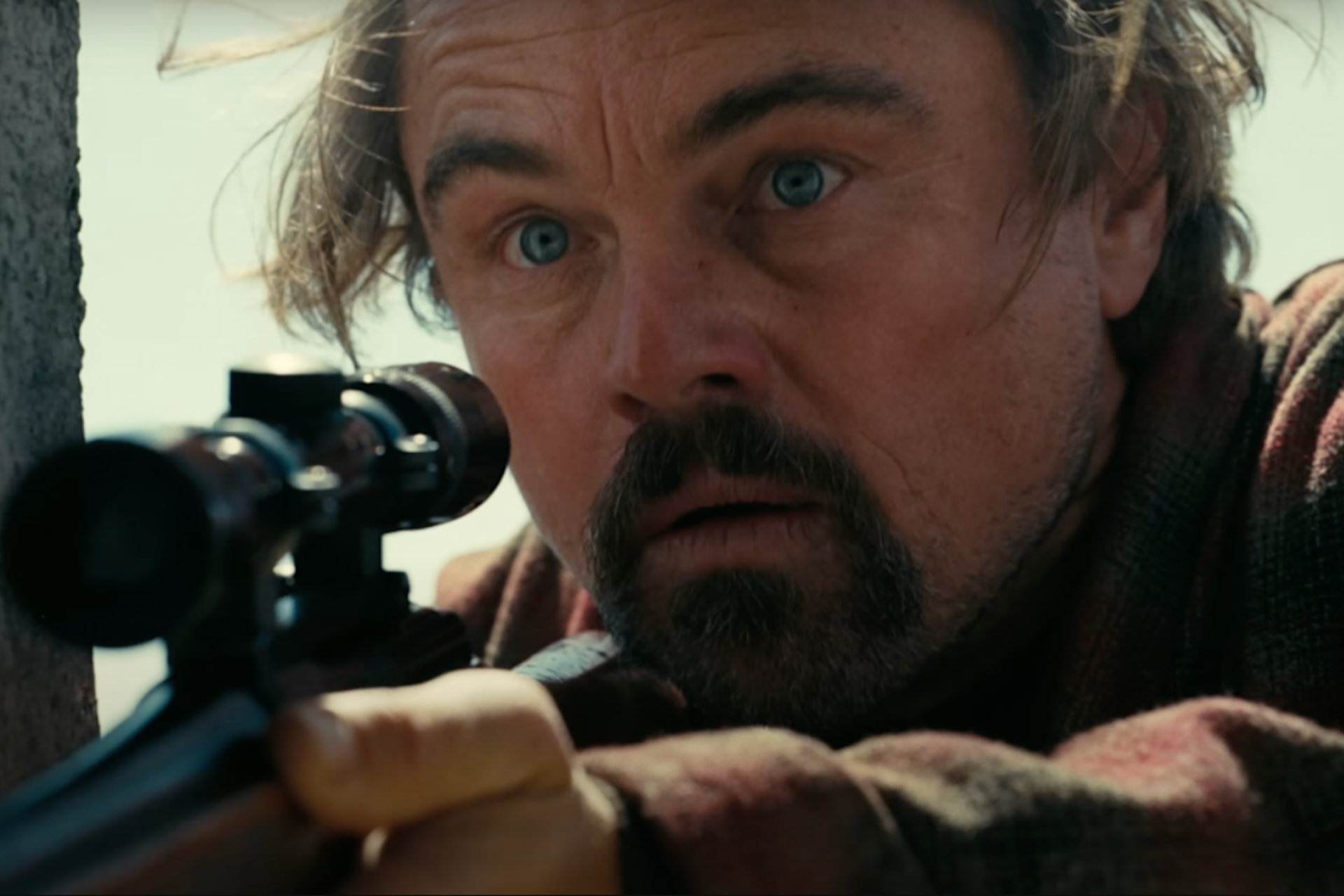
This is where I circle back and remind you that One Battle After Another is, for the most part, a pretty good movie, especially when compared to what you get at the multiplex each week. It’s often thrillingly constructed – the stretch of the film in which DiCaprio and Del Toro link up, with DiCaprio looking for a place to power his ancient cellphone so that he can get back in touch with the French 75 hotline and Del Toro mobilizing his network of everyday do-gooders to protect the innocent is beautifully put-together, and it’s genuinely funny. DiCaprio’s moron-schtick remains endearing, and Anderson gives him a fuckload of material to work with. Chief among that pool of gags are his exasperating conversations with the revolutionaries over the phone, who are, if anything, sticklers for protocol. So when Bob can’t remember what one of the verbal passwords is, the person on the other end refuses to tell him any information, and he fucking loses it. It’s hilarious banter, enlivened by DiCaprio’s unstoppable moronic force smashing head-on into a wall of indifferent pseudo-bureaucratic gooberdom. Anderson’s wit is fully intact, and even the little jokes, from the way Del Toro reacts to DiCaprio’s fits of rage over the phone to Penn’s pinched and goofy walk to the décor surrounding the Burn After Reading-styled meeting of the racist minds that sums up Lockjaw’s side of the story for those not paying enough attention, land.
Yet the issue I have with One Battle After Another isn’t its politics (which are righteous and on point and such) or its humor or its performances: it’s in how it compares to the rest of Anderson’s filmography, and the depth that it lacks in comparison to something like The Master or Inherent Vice. Anderson’s rattled off masterpieces ever since Punch-Drunk Love (I am, and will always be, a person who does not care that much for Magnolia’s arch pretentiousness). His films have always had a rich center – a character, a time period, a concept, or, as often was the case, a perfect blend of all three. Here, that center feels obscured by something, be it pace (the narrative moves at Mach 5) or momentum (the individual scenes fluctuate between that top speed and school-zone limits) or modernity*** or the lack of Robert Elswit, Anderson’s longtime cinematographer, with whom he had a falling out at some point during or after Inherent Vice. God bless Michael Bauman, who moved up from gaffing to lensing Licorice Pizza once Anderson decided to delegate after shooting Phantom Thread himself, and I know I couldn’t do a job as well as he does here, especially when working with a process like VistaVision. Yet there are few truly transcendent images in either of the films he’s shot for PTA – I can distinctly remember the way Elswit framed fucking water in The Master – and I can’t help but imagine what this movie might have looked like in other hands. Or it’s the Jonny Greenwood score, which is just comparatively disappointing when held up next to his compositions for Phantom Thread or There Will Be Blood.
***PTA’s Wes Anderson-like descent into the past was, in my frank opinion, a net positive for him as a filmmaker (in terms of the rich aesthetics he could explore) and as a storyteller.
Whatever that missing element is, and I don’t know if I’ll ever quite figure it out, it’s the thing that keeps this movie from attaining “shrug off the flaws” status. It is exceptionally long, earning the “epic” status by sheer heft; its attention is split across too many competing plots, as if No Country for Old Men got picked up for a series order instead of being pared down by McCarthy and the Coens into a feature. You don’t really feel the length until the final act, in which Anderson dovetails from mediocre comedy (with a decent payoff) straight into a pseudo-iPhone commercial, which feels out of sorts with the story’s angle. Perhaps it’s just entertainment fatigue – there’s so much happening here that, once it stops to exhale in the final moments, it sputters. Yet when taken as a whole, I don’t know if there’s anything in here that wasn’t said or done better in Inherent Vice, which had the benefit of being a proper Pynchon adaptation rather than merely inspired by one of his works. You can taste the missing fat in the “I Can’t Believe It’s Not Pynchon” substitute – the lack of melancholy or context or introspection that gives the work its depth and richness, even if it can make a decent metaphorical grilled cheese anyway.
I know this is a let-down – Over 2,000 words and still no provocative conclusion? – and that a shrug of the shoulders over what’s likely to be the Film Nerd Event of the Year (in VistaVision!) feels like a cop-out. Anything else would be unfair to you (or to Anderson) for me to say anything other than the truth, and sometimes, a flick just misses you. Yet there are two final questions I keep coming back to, both of which I often struggle with when evaluating movies from directors with whom I’ve formed a natural parasocial relationship that accompanies admiration. First, if this movie were directed by Anderson Paul Thomas, a relative unknown whose first few features I’d have missed for some reason, would I still be singing its praises? Or, second, is the context that I or a viewer like me will bring to this – being astonished by There Will Be Blood as a high schooler, deeply moved by The Master midway through college and precociously (and often pretentiously) enamored with Pynchon all the way through – blinding me to the brilliance of One Battle After Another as a work of compelling, entertaining, Hollywood-at-its-finest, populist art? I don’t think they’ve got good answers, but I will say that their whispers kept me from fully enjoying or immersing myself in Anderson’s triumph. Trust me, if you enjoy this parade and the celebrations of the man’s talent, know that I’m envious and that I hope to join you again next time around – this is just one battle I lost, and there’s still more to come.