
Jared Hess really was the right person to direct A Minecraft Movie. Why? Well, it’s because Minecraft, as a cultural force, is cringe. There’s just something inherently adolescent about the Mojang video game that adults and sufficiently jaded teens find oddly repellent, perhaps because it’s a fad that never quite went away, even with competition like Roblox (a heavily monetized rip-off) and Fortnite (whose crafting mechanics owe a certain amount of credit to). Strangely, I think it has something to do with the base game’s timeless quality. While Epic Games and the Roblox company chase trends, one can still play vanilla Minecraft and lose a few hours. The game’s rhythm has always been well-paced and rewarding — learn, evolve, explore, and create. Yet it’s less of a game at this point and more of a platform (though it can still be enjoyed solo), where friends can gather and create their own fun. Its aesthetic remains as plain and strangely endearing as it ever was: the blocky textures, the calming Eno-esque ambient soundtrack, and the bizarre little critters and monsters that scurry about. As such, it’s at the “terrible teens” point in its cultural lifespan, in which enough of the player base has aged out of active enjoyment, but the game isn’t old enough to become properly nostalgic (a la The LEGO Movie). Hence, the extreme reactions you see online and why so many people thought it was a terrible, unnecessary idea to make a movie out of it in the first place.
That much is true — it was a bad idea to make a Minecraft movie because video game adaptations are always risky, and there’s no telling what the studio will wind up with. It might flop (like Super Mario Brothers), and if it is a success (like The Super Mario Brothers Movie), you’ll wind up with haters like myself saying that it’s a poor substitute for the experience of playing the games. Platform movies are also difficult to sell, given that the two aspects that make them enticing — player freedom and community — are wholly absent from narrative cinema. For instance, the very solid Dungeons & Dragons: Honor Among Thieves flopped the same year that Baldur’s Gate III broke sales records, partially due to the “make your own fun” aspect: It was a good single-player translation of the tabletop experience, complementing the modern-day RPG boom. Honor Among Thieves did nothing to distinguish itself, nor does it possess the same cultural cachet as properties like Mario or Mortal Kombat. Worse, fans hate cringe and aren’t above forcing a studio to change things to sate their desires. After all, there was an ethos behind that original Sonic design, as ugly as it was, that never got the chance to make a case for itself after the first trailer.
The reactions were similar when Hess, a connoisseur of cringe with a hyper-distinctive style, debuted his take on the Minecraft world. On one side, you have the fans, who hate anything that deviates from the established median, and on the other, you have the enlightened cinephile, who dislikes style even as they claim to yearn for it, should it be applied to something they see as soulless. IP has a strange tug-of-war on their souls: Movies like this should never be made, and original ideas should be nurtured to release, but if these movies are to be made, they shouldn’t try anything too weird, lest they do something interesting, become successful, and perpetuate the trend. Though it is hard to accept, the reality is that the IP arms race hasn’t bottomed out and that “slop” is better for everyone when it has some aesthetic merit. Hess brings this to the discussion, as there’s a deliberate through-line between his midwestern suburban aesthetic and his bizarre yet enticing attempt to make the video game “real,” or at least compatible with the presence of flesh-and-blood humans.
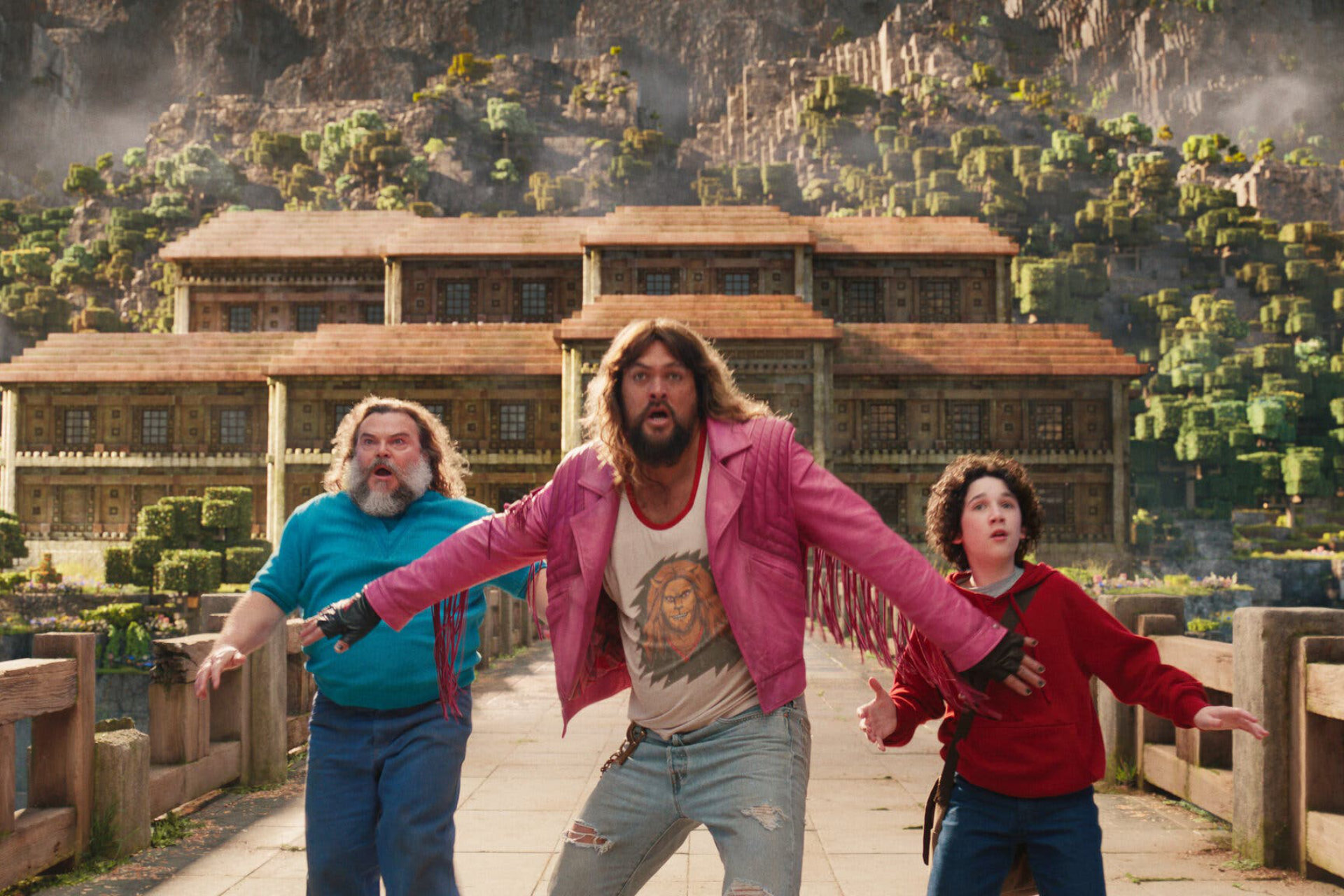
You’ll be surprised to discover that most of A Minecraft Movie takes place on the sunny landscape of the “overworld,” the most familiar location to those who have only ever seen the game’s cover art or who only ever survived a single night when they booted it up. Hess eschews CGI logic — that poorly-lit nighttime scenes are better for hiding the digital seams — for a sturdier one, in which as much as possible in any given scene should be practically created and simply enhanced with digital effects (a lesson that Hollywood forgot once Marvel doubled-down on CGI-everything and no one in the audience seemed to care). This adds enough of a tactile reality that it doesn’t feel weird when a young nerd named Henry (Sebastian Hansen), his older sister Natalie (Emma Myers), her friend Dawn (Danielle Brooks), and past-his-prime video game champ Garrett (Jason Momoa) find themselves transported to the world. It’s vividly colored and tactile in its textures, the antithesis of the strange, blue-screen apparitions you’d see in something like Robert Zemeckis’s Here. The monsters, as well, are remarkably realized, with the main antagonist, a pig sorceress (Rachel House), being a fantastic blend of Henson-like Dark Crystal puppetry and animation. The actors aren’t talking to tennis balls; they interact with physical things on the set. The same goes for Jennifer Coolidge, who riffs with a “villager” — a large-nosed, faux-human character — and, again, has a human to look at on a very real set.
This is why Hess succeeds here: the effects work is stunning, and his direction is sturdy. The action is crisp, clear, and cleanly edited (it’s a low bar to clear, but with as many moving parts as one has behind the scenes, the fact that we have unbroken fistfights is a near-miracle). The ensemble smartly executes his physical comedy as well as they deliver his punchlines, which remain as juvenile and occasionally funny as they were in Napoleon Dynamite or Nacho Libre. This movie elicited at least five good laughs from me (with a throwaway gag Coolidge delivers at the climax of a scene being the funniest moment I’ve seen in a studio picture this year), and it’s decidedly adolescent in a way that would make a Disney executive blush. I want to call this “Barbie for STEM kids,” with how thorough both are in realizing their aesthetic visions of a child’s imaginary playgrounds as a cinematic reality, but it reminded me of Speed Racer: madcap, propulsive, and funny, though it lacks the Wachowskis firing on all post-Matrix cylinders. That, too, committed to all of its bits, and also embraced its adolescent nature, avoiding the trap of the morality play in favor of a kind of kinetic freedom. You’ll notice that I don’t mention anything about the plot here, as it’s not particularly important. Hess doesn’t care about “canon,” nor does he have a desire to pump the brakes to make Jack Black deliver exposition. He could be doing a goofy-ass song about his dog instead, which is by far what the film’s intended audience — children — want to see.
A Minecraft Movie’s lack of consideration for what the adult or jaded-teen audience members want and Hess’ rigid commitment to realizing the film with his particular palette are the keys to its success. It’s not a film made for the “fans,” which sounds counterintuitive but becomes starkly apparent when you compare it to Sonic or Mario, both of which strived to balance the needs of adults (whose thumbs are ready and waiting to pounce on any misstep the filmmaker might make for retweets and likes) and the wants of children. Those movies could find audiences because they made these respect-generating compromises, forsaking memorability for fleeting respect. Hess doesn’t give a fuck about any of that. If he had, he wouldn’t have made Gentleman Broncos after Nacho Libre, nor would he have spent the better part of a decade making Sandler-esque “messing around with my pals” movies instead of striving for a hit. You can dislike the end product and hate that we’re in a situation where A Minecraft Movie could hit theaters.
Still, you have to give it to the guy: He went into the studio IP maw and escaped from the same hole he went into with his aesthetic integrity fully intact, when many of his peers would have gladly bent the knee. Other productions, like Sonic before them, would have leapt into action to correct the visuals following that first trailer, but they held firm. As the meme goes, Minecraft and Hess are cringe, so they are free.