
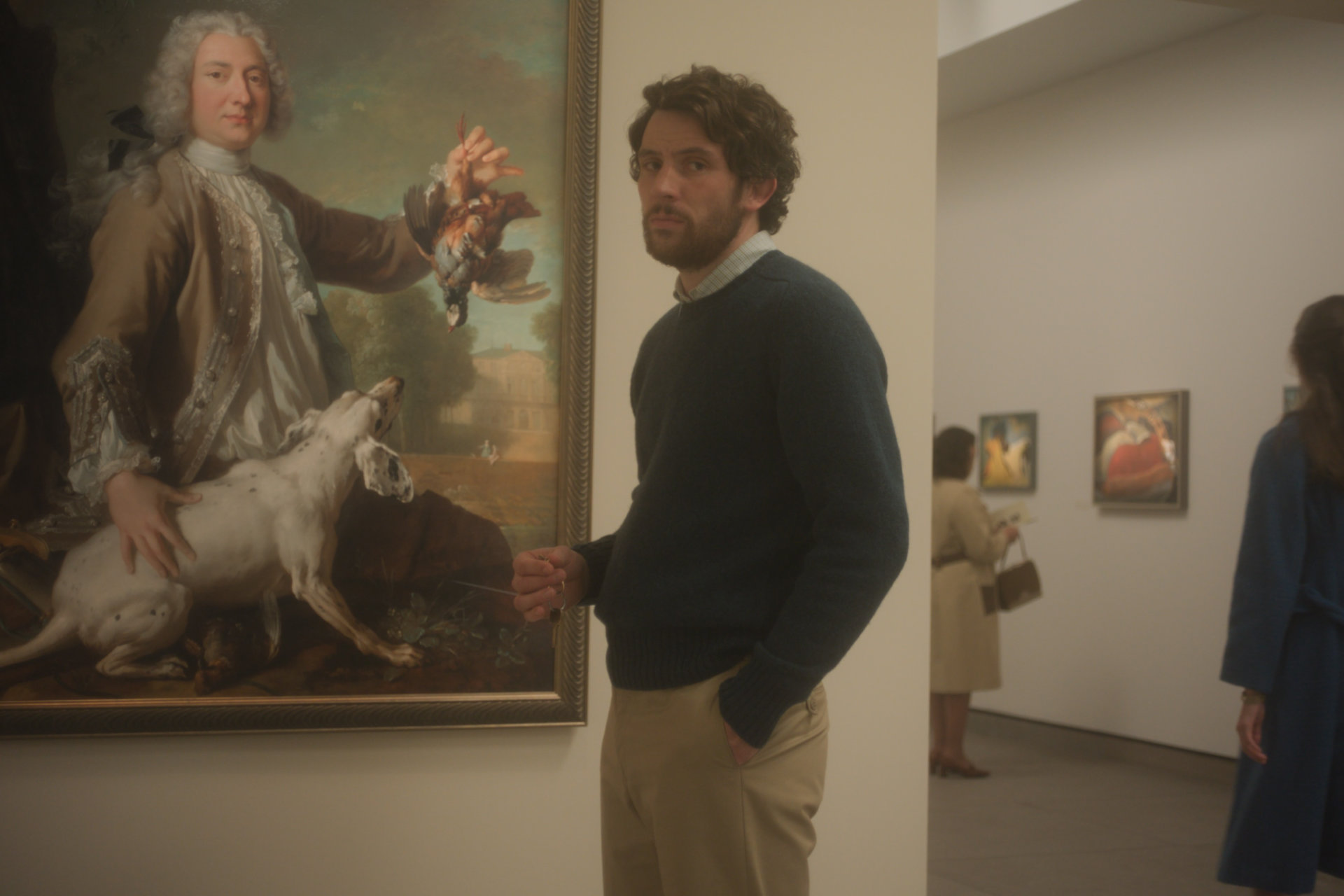
When you think “Massachusetts art museum heist,” it’s understandable that you’d default to the one that took place at the Isabella Stewart Gardner Museum some 35 years ago. You know the one: The subject of a million “whodunit” documentaries and endless speculation (as well as one solid crime novel, Charlesgate Confidential, which transplanted the heist to the ’40s and heavily involved the mythos of the Charlesgate Hotel), where the paintings were cut from their frames and potentially lifted by a husband-and-wife couple later caught with a stolen de Kooning when their empty house was cleared out after their passing. But we’re too smaht to merely have one little art heist in our pasts, and it’s in the robbery that took place at the Worcester Art Museum in the mid-’70s that Kelly Reichardt’s The Mastermind draws its inspiration. The location may have been changed — Framingham, your art museum would be on the map in this world — and the paintings stolen altered to four Arthur Dove works instead of the Rembrandt, Gaugain, and Picasso works lifted from that museum’s walls, but the specifics are roughly the same: Two men walk in, one with a gun, and walk out with treasure as if it were a Southie liquor store. The difference is who’s in the driver’s seat.
In literal and metaphorical senses, that’s James “JB” Mooney (Josh O’Connor), whom the ironic title dubs as the brains behind the gig, responsible for plotting the score, but you couldn’t really accuse JB of being a “master mind.” It’s a sloppy, shitty heist: A carpenter by trade and training, he puts more care in assembling a box to hide the four Dove paintings than he does the robbery itself. Turns out stealing paintings off the walls is a bit more complex than his first gig, quietly lifting a wooden figurine from a display while the guard dozes off. This is a real slapdash job that has you wondering what the point of the recon-as-family outings was in all those months leading to the big day, all brought on by some sticky fingers. JB’s not even supposed to be there, after all. His problems started when his getaway driver dropped out, continued when his criminal buddy (Eli Gelb, known to theater audiences for his work in Stereophonic) hid his mob ties, and got their piece de resistance when the last member of his team (Javion Allen) brought along a gun.
It’s a miracle it doesn’t go off. Then JB wouldn’t ever see his mostly-silent wife (Alaina Haim) and goofy little kids again. Or his dad (Bill Camp), an overbearing judge who’s disappointed in his son’s choice to become a carpenter, and Mom (Hope Davis), who can’t seem to stop nagging him about all the debts he’s accumulated over the years. He wouldn’t have to confront the fact that he’s a fuck-up, really, caught in a period of American turmoil, and he wouldn’t have to get a job and give up the dreams of an artistic life.
That’s right — JB’s caught a case of the Close Encounters, only the magical life he’s spirited away to isn’t one in which he’ll be exploring the cosmos with the Greys. It’s a shitty life on the run, coasting from couch to couch, bearing down the eyes of folks who can’t quite understand why he’d do such a dang foolish thing. This isn’t that South Boston liquor store, where insurance will replace the cash in the till and the swiped bottle of Evan Williams grabbed in haste on the way out. It’s art, and not the kind that’s sequestered away: it’s as close to public ownership as it gets over here, meant for the collective good. Ask him he if he had a high-minded plan, or, as one of his old college buddies (Gaby Hoffman) suggests, intentions to offload the goods with a disgraced professor as a “fence,” he’ll coyly tell you it’s wrong, and smile, letting the ambiguity substitute for the fact that he just really liked how those works looked on his wall and that it was something he could do. When, on the lam, he tries to tell his wife that he “did it all for them,” he means something behind all that bullshit; that doing this robbery meant that maybe he’d finally do something worthwhile with his up-to-this-point useless life. If he couldn’t be good, he’d be clever, and perhaps that’d be a point of pride to a family held aloft by her hard work that might see him as a sort of ceremonial figurehead.
Of course, this might just be conjecture: Reichardt’s films give you enough quiet to insert your own thoughts, and working in a smash-bang genre such as crime hasn’t changed that. O’Connor is wonderfully enigmatic, which seems to be one of his default methods (Rebuilding is another feature he leads that has a similarly pensive lead character). Their combined patience allows JB to remain emotionally elusive even as he slowly gets snared in the traps laid for him. It’s not their fault that one can think of heist pictures that might make similiar points in stronger ways, or that the profundity of the setting feels more like window-dressing as applied than the potent thematic compliment it’s intended to be, with newscasts led by talk of student protests and full of uncut Vietnam footage (one could have set this at any low-trust point in the last 50 years of American history, and it would have had just as much as heft as applied here provided one could believably stage a brazen heist at an art museum).
That’s all beside the point when you’re dealing with a Reichardt character study, in which you’re lulled in by its hypnotic blend of well-tempered observation and perfectly-crafted visuals, punctuated by the occasional thunderclap caused by a particularly potent and often-bitter laugh. As much as I missed the uncommon sweetness of First Cow, or the gut-punch of Wendy and Lucy, there’s something fascinating behind The Mastermind‘s portrait of general malaise, in which crises of conscience and confidence confront a man and he fails them, embracing a bullshit romantic life on the run up until his despairation brings him to a fittingly ironic ending. Hell, he’d probably insist he wasn’t even a crook, just a misguided dreamer.