
For a superhero team so central to Marvel Comics’ modern history and overall identity that they’re known as the “first family,” attempts to bring the Fantastic Four to the big screen have often felt like afterthoughts. The first live-action adaptation didn’t even make it to theaters; Tim Story’s two entries epitomized aughts mediocrity, stoking fanboy ire with each misstep even as they brought home the bacon for Fox; and Josh Trank’s Fant4stic was an out-and-out disaster that, when I saw the film back in 2015, the father-son duo trying to record the movie on their iPhones gave up in frustration and left the theater after a half hour. The Lee-Kirby creation has always been out-of-step with cinematic trends — too expensive to realize in spendthrifty eras, too goofy for the grim and gritty years (the cloud Galactus and so on) yet too serious to play straight without a wink and a nod — and their best on-screen appearance came in a Disney knock-off with added Randian bullshit courtesy of Brad Bird. Indeed, it often felt like those comics were better served as an influence rather than a direct source, and that any attempt to compete with their progeny would have them in the same boat as John Carter or The Spirit. But desperate times call for desperate measures, and the Four were, from their creation, a Hail Mary toss meant to save Marvel from utter ruin. So, it’s fitting that Matt Shakman’s The Fantastic Four: First Steps has been positioned as the solution to Kevin Feige’s extensive list of woes, a last-ditch effort to make the lead-up to their next MCU-quaking Big Event meaningful. What’s surprising is that it’s not half bad, despite everything working against it.
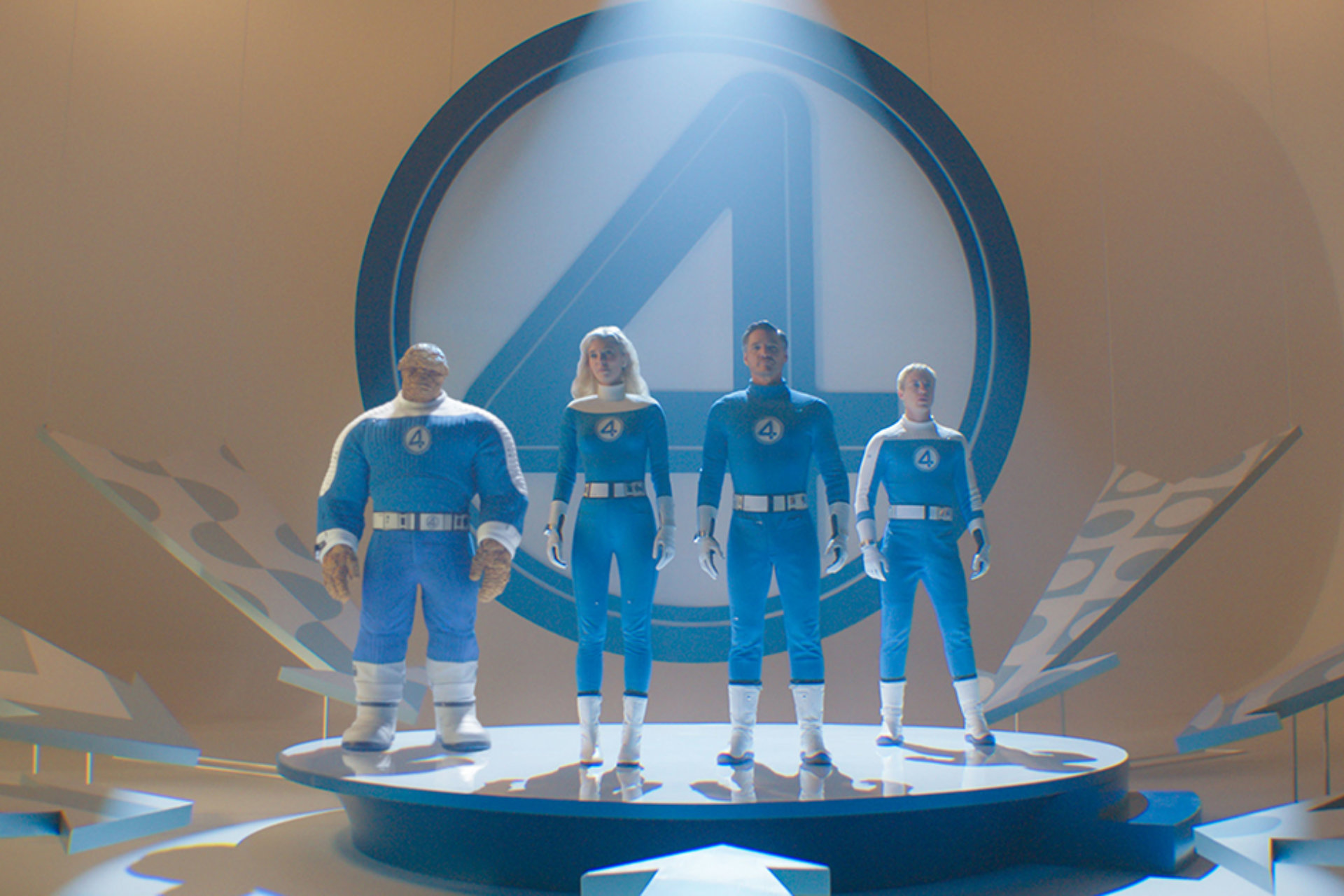
That’s right, First Steps is a repudiation of the governing logic of Marvel Studios for the last decade, which means it feels like a real movie. It’s in a parallel universe – one in which the ‘60s never really ended, at least stylistically – mercifully devoid of the type of franchise-building horseshit these movies are suffused with and, despite what you might think the after-colon title would imply, it’s not an origin story. Super-genius Reed Richards (Pedro Pascal) can already stretch himself to fill in the last steps of an equation on an overly-long chalkboard; Sue Storm (Vanessa Kirby) can turn herself invisible to avoid angry diplomats at the United Nations; Johnny Storm (Joseph Quinn) can set himself ablaze and take to the skies; and Ben Grimm (Ebon Moss-Bacharach) has to use an angle grinder in order to shave off the stalactite stubble that grows from his rocky visage. Mr. Fantastic, the Invisible Woman, the Human Torch, and the Thing are already heroes, well-known as the Fantastic Four, who have saved their city’s bacon plenty of times from threats like the Mad Thinker and the Mole-Man (Paul Walter Hauser). The public loves them, and the group genuinely enjoys being superheroes, though Ben has some reservations given the whole “rock monster” deal. But that all might change, as they’re about to face a challenge that they legitimately can’t just clobber or burn or force-push or stretch their way out of: Parenthood.
Well, no. Everybody likes the idea that Reed and Sue, the it-couple marriage of their era, are going to have a kid, to the point that odds-makers are offering bets as to what sex the child will be, and the tabloids are ablaze with rumors and speculations about the child’s potential powers. Johnny’s excited to be an uncle, Ben’s excited to be a godfather, and the only person who seems really worried is Reed. He takes fatherly concern to a new level, inventing new machinery and non-invasive diagnostic tests to run for his soon-to-be-born son, as he’s terrified that he’s burdened him with some super-powered curse or that, even worse, he’ll turn out like he did. But all that’s rendered moot when a naked silver lady shows up on a surfboard and declares to the Earth that it’s about to be gobbled up by her master. She is Shalla-Bal (Julia Garner), otherwise known as the Silver Surfer, herald of Galactus (Ralph Ineson, ideal casting given his incredible voice). He – if you can still really call it that – is a force as old as time itself, whose never-ending hunger causes him to seek out life-filled planets for his consumption (he doesn’t, like, detach his jaw or what not – he has a big old ship that converts all of that into a life-sustaining lava-like essence that’s circulated in his suit). Their attempts to parlay with the big guy go terribly, and he offers them a choice: Reed and Sue can give him their son – a “being of unimaginable power,” despite what Reed’s tests have told him – and he’ll spare the Earth. They tell him to kick rocks, and the countdown begins.
There are aspects of First Steps that are recognizably modern Marvel. The effects work, per usual, runs the gamut from “Ok, this looks pretty cool” to “Jesus Christ, Disney, you’re a multi-billion dollar company — why the hell can’t you get your CGI act together?” For a feature with several mostly-digital characters, it’s weird that the big building-smashing planet-eater is the one that looks the best, and not Moss-Bacharach’s or Garner’s, who have a lot more screen time. Garner’s appearance as the Silver Surfer is especially rough, her design burdened by the kind of comic-book detail that doesn’t quite work on screen (keeping her hair really fucks up the streamlined sleekness of the character’s appeal). There are also a few moments of banter that don’t work too well, feeling atonal amid the straight-faced yet sunny seriousness of the tale told (though, to be perfectly fair, Hauser’s brief appearance got the first legitimate laugh out of me in a Marvel movie in a long time). Yet what’s more important is how little it resembles its immediate kin — there’s a gulf separating this from garbage like Thunderbolts* or Captain America: Brave New World — and how it evokes Marvel’s glory days, back when they could make fucking Ant-Man into a hit.
If I had to pinpoint the Marvel movie First Steps most resembles, it’d be Captain America: The First Avenger in the way that it tries to evoke an era’s feel, both in design and attitude, while minimizing revisionist cynicism (that’s for the sequel). Though not as steady a journeyman as Joe Johnston, Shakman has that Rocketeer-like experience in crafting a retro-futuristic world well-suited for the cinema. I know for a fact that it’s one of the most detail-oriented Marvel movies – Johnston, James Gunn, and now Shakman are perhaps the only three directors who cared about the sets as something more than window-dressing (Coogler’s got them beat on costuming). The grace notes, such as the Four’s robo-butler H.E.R.B.I.E. having his cassette tape programming as a face, or the golden records that are auto-engraved with intergalactic transmissions ready for high-tech turntable playback, or the giant CRT ads in their equivalent of Times Square, only help to punctuate the level of thought that’s gone into creating this world where Donald Fagen’s “I.G.Y.” isn’t so much a wistful lamentation of optimism lost and childhood’s conclusion but instead a mere summation of daily life. Yet, unlike something like Brad Bird’s Tomorrowland, this world isn’t meant to scold us – it’s merely the place that these characters can exist in their ideal forms. Mundanity is beneath them.
Moreover, Shakman’s gotten even better now that he’s not tethered to the bad pastiche of Jac Shaeffer’s WandaVision scripts, and he has a purpose-built screenplay with at least four credited writers to suit his and Feige’s needs. It’s the Iron Man magic all over again, in terms of summoning a fully-realized narrative out of a writer’s pool under stressful circumstances, and I’m sure even more uncredited contributors had their fingers in the pie. The point is that it coheres well, even if it has some deliriously silly machinations – their first attempt at a plan to stop Galactus is suffused with what I like to call “Patrick Star logic” — which, in retrospect, is well in line with the early Lee-Kirby stories. What deficiencies remain are smoothed over by a genuinely delightful cast, who are, for the first time since Chadwick Boseman and Tom Holland showed up in Civil War, so well-suited that it feels like they were always meant to be in these parts. Pascal and Quinn are standouts, benefitting from the strongest writing: a short scene with Pascal and his son has more pathos in it than anything Disney’s done this decade (without involving animal cruelty, either!) while Johnny’s quest to prove himself as more than a pretty face to his brother-in-law is a surprising innovation on a character commonly known on-screen for comic relief and braggadocio. Well, that is, as the urban legend goes, unless a robot replaces him because they’re worried about kids setting themselves on fire.
At roughly 100 minutes, First Steps shows that Marvel can be economical without skimping on the good stuff – compelling characters in an involving story set in a fantastical world with some amount of grand spectacle. That’s right, folks: the finale involves more than two guys with different colored lasers zapping and punching each other in a darkened all-CGI environment, and the best action sequence in the film owes more to Chris Nolan’s Interstellar than it does any of Marvel’s predecessors. Ultimately, for the first time in years, the Feige-industrial complex has produced competent entertainment that can stand on its own. Should you not give a shit about Doomsday or Secret Wars, the movie never makes a lengthy diversion to plug coming attractions – it just doesn’t have the time as it works to make you smile. It’s crazy what happens when Marvel focuses on what they’re good at, instead of courting critical acclaim that will never come or making three-hour trailers for movies that are a solid decade away from release. Take it from a certified hater: you gotta give it to them when they’ve done a good job. So, well done, Marvel, Fantastic Four proves you still have some gas in the tank. It’s just a bummer it’ll take another seven years and 40 hours of drek to get another movie like this.