
In case you haven’t heard, there’s a new Darren Aronofsky movie, Caught Stealing, that’s essentially being shadow-dropped into theaters this weekend, despite being directed by a Big Name and starring one — Elvis himself, Austin Butler — as well. This is, well, weird. In the yo-yo arc of Aronofsky’s career, he should be on the upswing, having been given a second second chance with The Whale and helping win Brendan Fraser an Oscar in the process, and it feels like this was bound for another fall-or-spring weekend without an outdoorsy holiday tagged onto it as a brat-and-beer afterthought. No one prominently wears white or celebrates the glorious victories of organized labor – why bury this, what might be Aronofsky’s best feature since The Wrestler, in a known graveyard? Beyond the everyday chaos magick behind studios’ scheduling schemes, I think the answer has something to do with how this work is very much a traditional Aronofsky movie, as the man has a through-line and refuses to break from it. This creates an uneven balance in the thematic stew, a feeling that there is another cook in the kitchen fighting him at every turn — and the problem is that I wish Aronofsky lost.
Call that Aaronofsky the “Cool Darren,” who threatens us with a good time before the Aronofsky we know and give F Cinemascores to makes an appearance. Cool Darren’s got a full-fledged wrong man potboiler ready for you to enjoy, and he’s assembled a fantastic cast to perform it. Based on Charlie Huston’s novel (with the writer admirably performing script duties), Caught Stealing is about the worst week that Hank Thompson (Butler) has had in a few years. He’s a barkeep on the LES in the days right before the Strokes and the towers came down, a California expat who still dares to wear a Giants cap and talk incessantly about his team even as the Mike Piazza-led Mets battle them for post-season pole position. It’s the last days of Alphabet City as it was before the Duane Reades moved in and the rising rents forced this cast of misfits and losers out. He’s got a solid little life – his boss (an unrecognizable Griffin Dunne, checking off the After Hours nod box) lets him drink as much as he wants, his amazing girlfriend Yvonne (Zoe Kravitz) puts up with his shit and still somehow likes him, his mom loves him and calls him every single day, and he’s got a great apartment. I mean, fuck Friends, this is what people dream about today when they want to move to NYC. He doesn’t know how good he’s got it. All he can see is the big fuck-up that brought him here instead of on the diamond with the Giants.
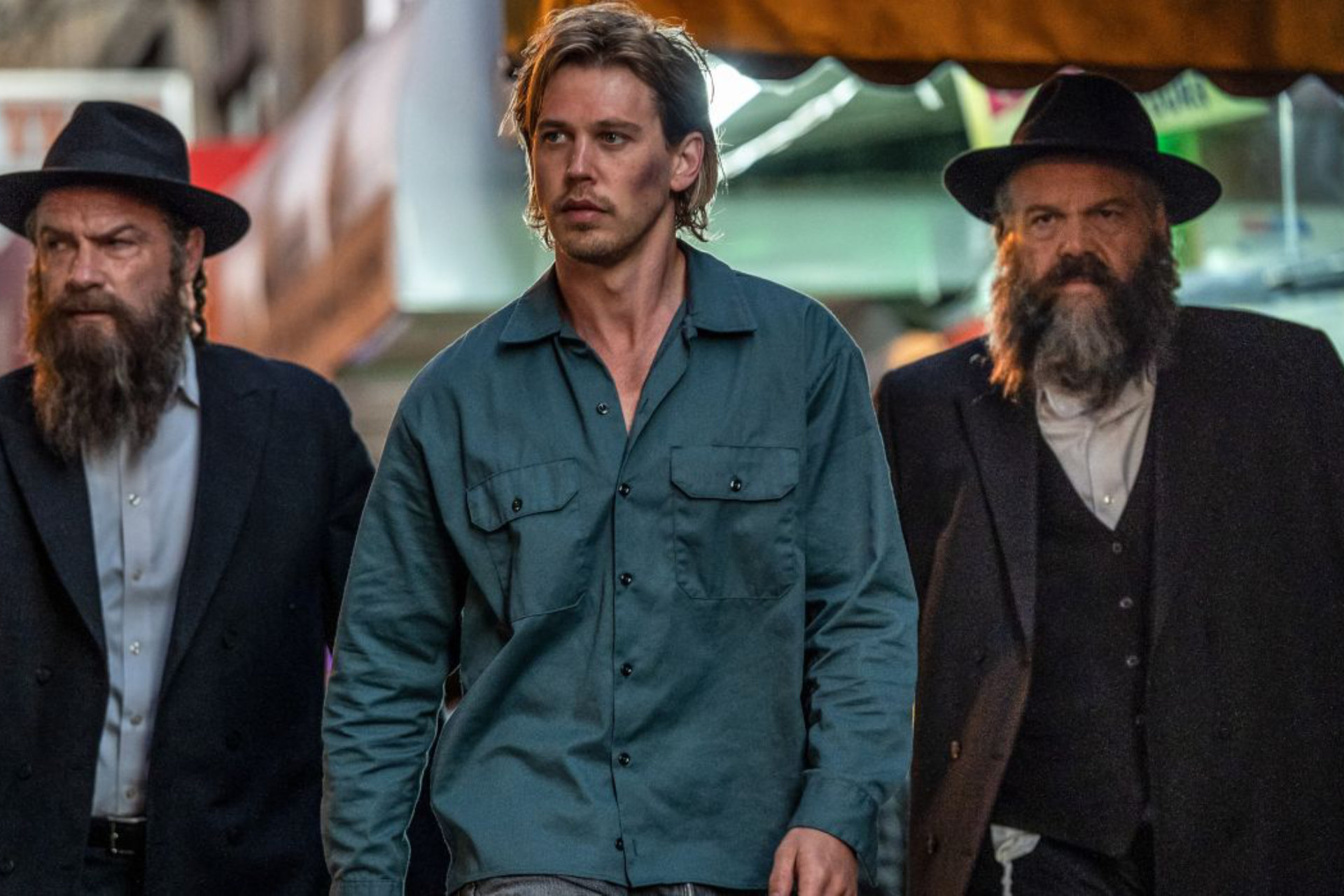
Like I said, great apartment. Only problem is the neighbors, as it is with great pads like that. Specifically, his neighbor, Russ (Matt Smith), a punk ne’er-do-well, has a bad habit of skipping town and leaving Hank with his adorable cat, Bud. Bud’s a biter, but for whatever reason, he loves Hank. So, when Russ’ dad has a stroke and the trad-punk has to head back to dear ol’ Blighty, the poor kitty is pawned off on his neighbor. This sets a nightmare in motion – a day or so later, a pair of Russian mafiosi bang on Russ’ door, Hank goes to check it out, and gets the shit beaten out of him for his trouble (we’ll come back to this). When he’s all recovered and ready to put it all behind him, it turns out that fate isn’t quite done with him just yet. He spirals into a scheme involving a corrupt cop (Regina King), a Russian mob boss too goofy for Anora, and two brothers (Liev Schreiber and Vincent D’Onofrio) who are as strictly committed to the ruthless execution of their enemies as they are to their orthodox Judaism. As he dodges bullets and plots his escape, Hank can only wonder one thing: what the hell did he do to deserve this? Turns out he knows exactly what he did, and even though it’s not related to the matter at hand, he can’t help but feel like it’s the Piper coming for payment. The cat gets out well enough, though.
However, you can’t really say the same for the main cast, and that’s where good ol’ Aronofsky shows up. See, Cool Darren is too busy working out fun banter between Butler and his co-stars, especially Kravitz and King, making the movie as thoroughly charming as it is engaging, or he’s too busy planning out fun little set-pieces, like a car chase across Flushing that winds up at Shea right as a game ends. Or he’s immersing himself in the lovely little details of ’98 NYC that appear strewn throughout, gleeful reminders of an era long-gone-by that goes deeper than just the WTC towering over things (cell phone minutes! Giuliani banning dancing in bars!). That leaves Aronofsky enough space to try and figure out how to make you pay for your entertainment, and I don’t mean by convincing you to see it in theaters instead of sailing the high seas or waiting for streaming. To use the oft-quoted bit o’ Bard, violent delights tend to have violent ends, and Aronofsky likes his to exact a heavy price. That beating I mentioned? Hank loses a kidney. Those colorful characters we quickly fall in love with? Well, they’re not going to have that comfortable retirement.
It all feels very familiar — specifically that one story about a bet between God and the devil to see if they can break that unsuspecting righteous man, Job. At a certain point, it becomes hard to ignore that this is the throughline that unites all of Aronofsky’s work, as it’s not like there’s a Straight Story to complicate matters. Math Job, Heroin Job, Widower Job, Macho Man Randy Job, The Jobcracker, Job on a Boat, Earth Mother Job, Fat Job — the only thing Aronofsky enjoys more than punishing his characters is doing the same to his audiences. It’s just a very staid and well-worn set of thematics, easy to dismiss if they weren’t so blatant and heavy-handed in their application at the expense of everything else he’s doing. Huston’s not especially to blame for this, although I imagine his script truncates the bits of his novel that pad out the moments between us being reminded of Hank’s never-ending suffering. It’s more that Cool Darren and Aronofsky never manage to mesh in a way that would make Caught Stealing truly sing aseither a romp through the NYC underworld (After Hours) or a seedier and earnest exploration of guilt and grief (Good Time). There are, after all, other key texts in the Abrahamic faiths to consider for storytelling fodder.
The only time this has really worked well for him is in The Wrestler, where Robert Siegel’s deeply human, empathetic script and Mickey Rourke’s brilliant performance manage to make Aronofsky see the beauty in his lead instead of that character’s suffering. It’s a credit to Cool Darren, Huston, and especially Butler that Hank comes the closest to equaling Randy the Ram in sheer humane likability. It’s really hard not to feel terrible for this dude, even if he did a truly shitty thing in his past (Aronofsky has to resort to dialogue to make that moment precisely land, because as its presented here, it’s understandable that, in the specific flashback, he’d be much more worried about some factors more than others without the reasoning supplied by exposition).
Butler brings soul to the role, less a Pattinson Brando-type or a Dunne yuppie-goof than just a close-to-platonic-ideal of “goofy, likable shithead you’d find serving moldy Stella in the LES on a Tuesday night to finance guys and kids with decent fakes.” He’s the connective tissue that makes Caught Stealing work as an amiable yarn with a solid resolution, even if much of it is more of the same “only through suffering can we achieve absolution” shit that Aronofsky can’t help but indulge himself in. In short: Let Cool Darren cook, my man.You might be surprised at how fun it is to let loose.